
XAI has introduced Grok Voice 3.0, a free API for an AI voice agent. XAI reports that the new model tops Artificial Analysis’s speech-to-speech AI benchmark, with a score of 86.9. It also claims that a similar AI agent is being used to handle some 70% of 20,000 daily calls for support at Starlink. These sources are xAI’s own claims. However, the announcement raises a very practical question for companies: if an AI voice agent can make calls to support customers at a cost of $4.80 an hour, how much does your support line cost?
What Is Grok Voice 3.0?
Grok Voice 3.0 is the newest version of xAI’s tool for creating voice-based AI agents for business. The API allows developers to integrate voice-based conversation AI into applications and customer support solutions. Unlike regular auto attendants where callers have to press buttons or navigate through predefined menus, speech-to-speech AI allows a conversation to occur through speech. The caller describes an issue in their own words, and the AI can reply with speech instead of following a prescribed menu.
It can also enable companies to take care of common questions, troubleshoots, and talk to customers beyond business hours. Developers can take advantage of the API and create voice experiences that are based on their own business operations and services. You can also explore Grok AI for video generation help in daily tasks.
Why xAI Says Grok Voice 3.0 Ranks First
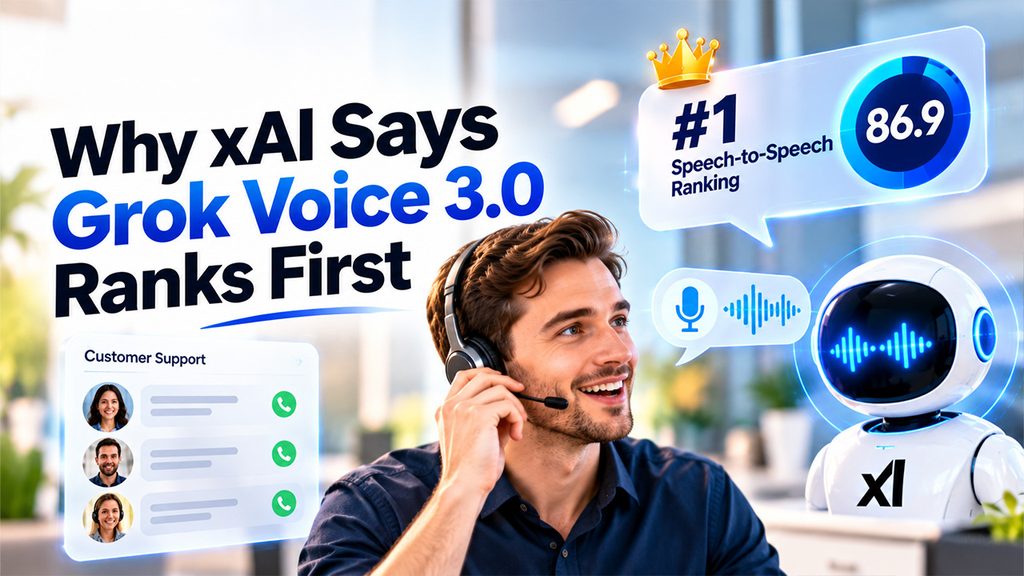
XAI says Grok Voice 3.0 received a speech-to-speech ranking of 86.9 from Artificial Analysis, which makes it the best in class. The ranking is a major aspect of the company’s pitch to enterprise customers looking to automate their voice interactions.
But benchmarks can’t measure everything. A voice AI system must also understand a variety of accents, interrupt, provide accurate responses, and manage conversations when consumers describe complex issues.
Companies should evaluate these features based on their required support before selecting a vendor. They should also test response times, chat quality, stability, and management of requests that cannot be resolved. This ranking provides potential users with an incentive to explore the API, but whether it can satisfy them depends on the time it takes in real life.
What Does $4.80 an Hour Mean for Businesses?
According to the specified rate offered by xAI, Grok Voice 3.0 will cost $4.80 for 60 minutes of use. This can be used by firms as a baseline for comparing voice costs to their current support team. This is the cost of this API usage rate, not necessarily the complete cost to operate a customer care team. Organizations can expect to pay for software and phone infrastructure, escalation, monitoring, and other service fees.
Nonetheless, the cost provides a valuable guide for firms trying to determine the cost of automating a call center that involves repetitive calls. The case for a call-center automation system becomes easier to make when it gets standard requests right, while lightening the load on humans.
What Companies Need to Consider Prior to Adoption
The per-minute cost might be low enough to make voice AI an appealing option, but whether it actually makes sense for a specific support process is still something companies need to figure out.
- Determine Right Calls: Calls that are repetitive and follow predictable patterns, for example account inquiries, information about services, or steps to resolve issues. These are good candidates for automation.
- Evaluate the AI With a Real-World Conversation: Customers will interrupt, change topics, use unclear speech, or ask questions that aren’t within the scope of the system. Your system should be able to identify these circumstances and escalate to a human representative, where necessary.
- Revisit Security and Compliance: Data handling, access permissions and call recording policies should also be reviewed. Support conversations may contain sensitive financial and personal data; safeguards are just as important as speed and pricing.
And last but not least, compare the numbers to current support metrics. Resolution rates, customer happiness, average handling time, and how many calls were diverted to a human to assist should be a little easier to look at than just the advertised price. Now the question for companies is no longer whether voice AI is coming, but whether they will lead the change or follow it.