Nvidia has launched new open-weight AI models designed to run agents in enterprise environments and on personal computers. The release includes Nemotron 3.5 Super VL, a 120-billion-parameter model for enterprise tasks, and two smaller Bolt models designed for local AI PCs and DGX Spark workstations. According to Nvidia, these models help businesses run AI agents on their own infrastructure while allowing PC users to complete tasks without sending workloads to the cloud. The company also names Salesforce, EY, and other businesses among the users of Super VL. The announcement highlights Nvidia’s focus on making AI agents more accessible, adaptable, and suitable for different computing environments.
What Is New in Nvidia Nemotron 3.5?
The main launch is three models meant for different use cases. Nemotron 3.5 Super VL is meant for enterprise applications, while the two Bolt variants can run AI locally on compatible computers. Nvidia says the models are open-source models, which it says gives businesses more room to customize and deploy them versus solely trying to run closed AI systems. The Super VL is made up of 120 billion parameters. Nvidia claims that while Super VL has fewer parameters than the Nemotron 3 Ultra, a higher-end model (630 billion parameters), it has the same levels of accuracy with instruction-following and tool-usage tasks.
Such actions are key for AI agents that need to follow instructions and make use of software tools. Nvidia also says Super VL can outperform competing models from OpenAI and Anthropic on some agentic tasks after certain post-training. Those are document intelligence, financial accounting, scientific experimentation, medical insurance claim processing, and security testing. But those claims are made by Nvidia based on the tasks and how they’re tested.
How Do the Bolt Models Run AI Agents on PCs?
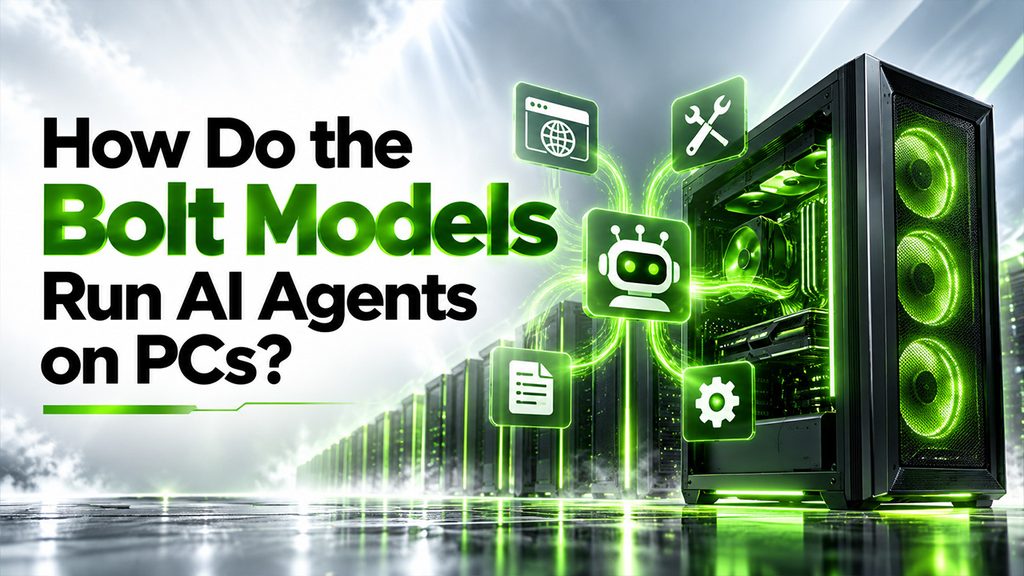
The Bolt models focus on bringing AI agents directly to local computing devices. Instead of depending entirely on cloud-based AI services, users can run supported AI workloads on compatible PCs and workstations. Nvidia Nemotron 3.5 Bolt 74B-A9B 24GB is designed for local agentic tasks. It aims to balance speed and reasoning while supporting multistep reasoning, tool calling, and web browsing. These capabilities can help users manage everyday projects and automate tasks through locally running AI agents.
The smaller Nemotron 3.5 Bolt E4B model focuses on conversational agents. It provides another option for applications that require AI-powered conversations rather than the more demanding reasoning capabilities of the larger model. Nvidia says Super VL and Bolt 74B-A9B are available now, while Bolt E4B is expected later in October. The models target different needs, allowing businesses and individuals to choose according to their hardware and workloads.
Cloud AI vs. Local AI: What Should Businesses Choose?
The launch raises an important question for business owners: should they use cloud-based AI services or run AI agents on their own computers and infrastructure?
The right choice depends on the organization’s priorities.
| Factor | Cloud AI | Local AI |
| Data Handling | Data is processed through a cloud service | Workloads can remain on local infrastructure |
| Hardware | Provider manages the computing infrastructure | Business needs compatible hardware |
| Scalability | Resources can scale through the provider | Capacity depends on available local resources |
| Maintenance | Provider manages much of the infrastructure | Organization manages deployment and updates |
| Best Suited For | Flexible access and scalable workloads | Greater infrastructure control and local processing |
Cloud AI relies on large-scale AI data centers, while local AI depends on the hardware a business owns. Neither option suits every business. Cloud AI can be more convenient for organizations that need flexible access to advanced models, while local AI can appeal to companies that prioritize data control and on-device processing.