Google has announced an important update regarding Search Console that helps website owners understand how their content performs in AI-powered search experiences. With the launch of Generative AI Performance Reports, Search Console now provides dedicated reporting for AI Mode and AI Overviews. It allows site owners to measure how often their content appears in Google’s AI-generated responses.
Earlier, AI-generated impressions were grouped together with standard Web Search performance reports which made it difficult to differentiate AI visibility from traditional organic search. However, the new reporting changes that. How? By offering first-party analytics specifically for AI search experiences. Understanding artificial intelligence at a foundational level makes it easier to grasp why search is shifting this way.
What’s New in Google AI Mode Search Console?
Google has added a dedicated Generative AI Performance section within Search Console that separates AI search visibility from standard search metrics. Instead of having AI impressions mixed with regular search data, website owners can now see exactly how frequently their content appears in :
- AI Mode
- AI Overviews
- Other supported AI-powered search experiences
This is significantly useful for marketers, publishers, and SEO professionals as it provides much greater transparency into Google’s AI ecosystem.
What Metrics Does Google AI Mode Search Console Show?
The new reports focus on visibility metrics rather than traffic metrics.
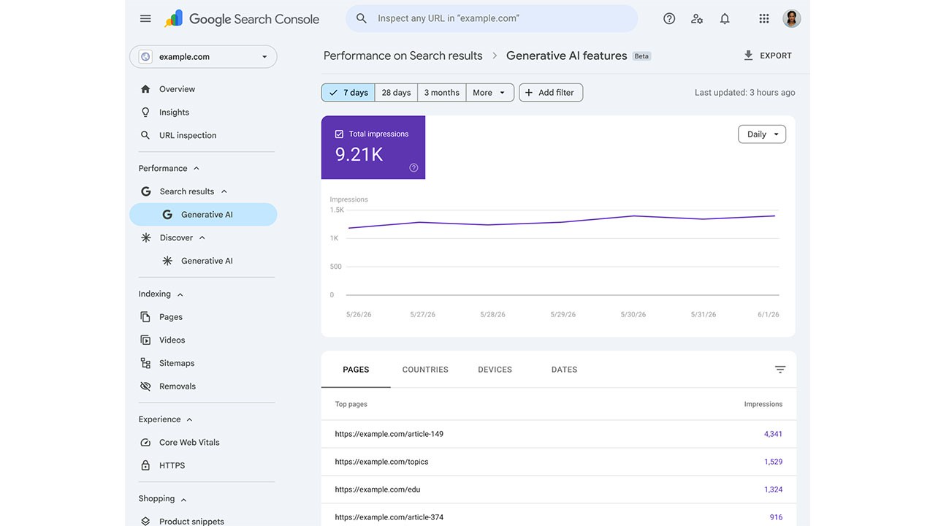
AI Impressions : The report shows how many times your pages appeared inside AI-generated search responses. This helps identify content that Google considers valuable enough to cite in AI-generated answers.
Top Performing Pages : You can view the exact URLs that are appearing in AI Mode or AI Overviews to understand which types of content Google prefers for AI-generated responses.
Country-Level Performance : Performance can now be segmented by country, allowing businesses to identify regions where their AI visibility is strongest.
Device-Level Insights : Reports are available across desktop and mobile devices, helping identify platform-specific trends.
Historical Date Filtering : Historical reporting allows users to monitor changes in AI visibility over time and evaluate the impact of content updates.
What Data Is Still Missing from Google AI Mode Search Console?
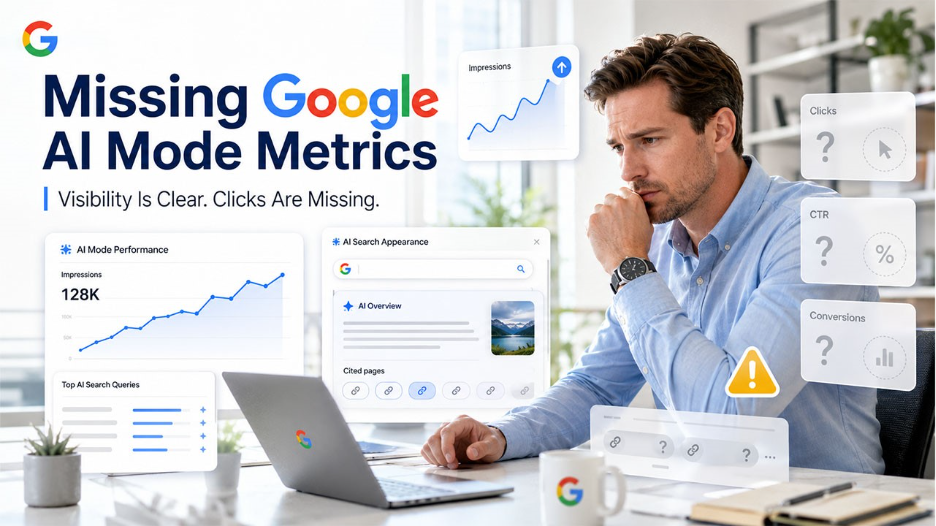
Although the new reporting is a major step forward, it has one notable limitation. It does not provide any click data. Google currently reports only impressions, not clicks.
This means you can see :
- How often your content appeared in AI-generated answers
- Which pages were cited
But you cannot yet determine:
- How many users clicked through
- Traffic generated from AI Mode
- Click-through rate (CTR)
- Conversions originating from AI-generated results
For now, the reports measure visibility, not user engagement.
Why the Google AI Mode Search Console Update Matters
This update lines up with several top AI trends in 2026 shaping search and content discovery this year.
Official AI Search Attribution:
Website owners finally receive first-party confirmation that their content appeared inside Google’s AI-generated responses. Instead of relying on third-party monitoring tools, Search Console now provides official reporting directly from Google.
Dedicated AI Visibility Tracking:
For the first time, AI search performance can be analyzed separately from traditional organic search. This makes it easier to measure Generative Engine Optimization (GEO) efforts without mixing AI exposure into overall SEO metrics.
Smarter Content Optimization Opportunities:
By identifying which pages appear most frequently in AI results, businesses can discover:
- Content formats Google prefers
- Topics with strong AI visibility
- Opportunities to expand high-performing pages
This insight supports more informed content strategies. Staying current with AI writing tools can help identify which content formats AI systems tend to favor.
SEO Impact of Google AI Mode Search Console
The introduction of dedicated AI reporting marks an important shift in how search performance is measured. Traditional SEO has long focused on rankings, clicks, and traffic. AI-powered search introduces another metric: visibility inside AI-generated answers.
As Google’s AI experiences continue to evolve, monitoring AI impressions may become just as important as tracking keyword rankings. Businesses can now evaluate whether their content is being selected as a trusted source within Google’s AI-generated responses, opening new opportunities to optimize for both traditional search and AI-driven discovery.
Do You Need to Change Your SEO Strategy for Google AI Mode?
Not necessarily. Google has confirmed that no new technical requirements are needed for AI visibility. There is no special schema, AI-specific markup, or dedicated AI sitemap required.
The same SEO fundamentals continue to matter:
- Publish helpful, original content
- Demonstrate expertise and authority
- Keep information accurate and up to date
- Improve page experience and accessibility
- Follow Google’s Search Essentials
Final Thoughts :
Google’s new Generative AI Performance reports mark the first official way to measure visibility in AI Mode and AI Overviews. The current focus of this report is on impressions rather than clicks. They offer valuable and actionable insights into how frequently Google’s AI references your content.
This update represents an important step toward understanding performance in the era of AI-powered search, especially for SEO professionals and digital marketers. As AI search continues to grow, tracking AI visibility alongside traditional organic metrics will become an increasingly important part of a modern SEO strategy.