
Introduction
Every now and then, a business term trends that sound complex but ironically describes something extremely simple. That is precisely the case with AI arbitrage. Essentially, it is the core gap between what a business charges for a result and what are the actual costs once AI is doing a portion of the work. As AI tools become faster and cost-effective to run, the gap keeps evolving, and the businesses that first notice it often capture the best value from it.
In this blog, let us break down what this term really means, how the core mechanics really work, where you see it in practice, and what are the risks that are associated with it. Irrespective of whether the context is a marketing agency, an e-commerce operation, a trading desk, the core logic that runs the AI arbitrate remains consistent, even if the execution looks slightly different from one industry to the other.
What Is AI Arbitrage?
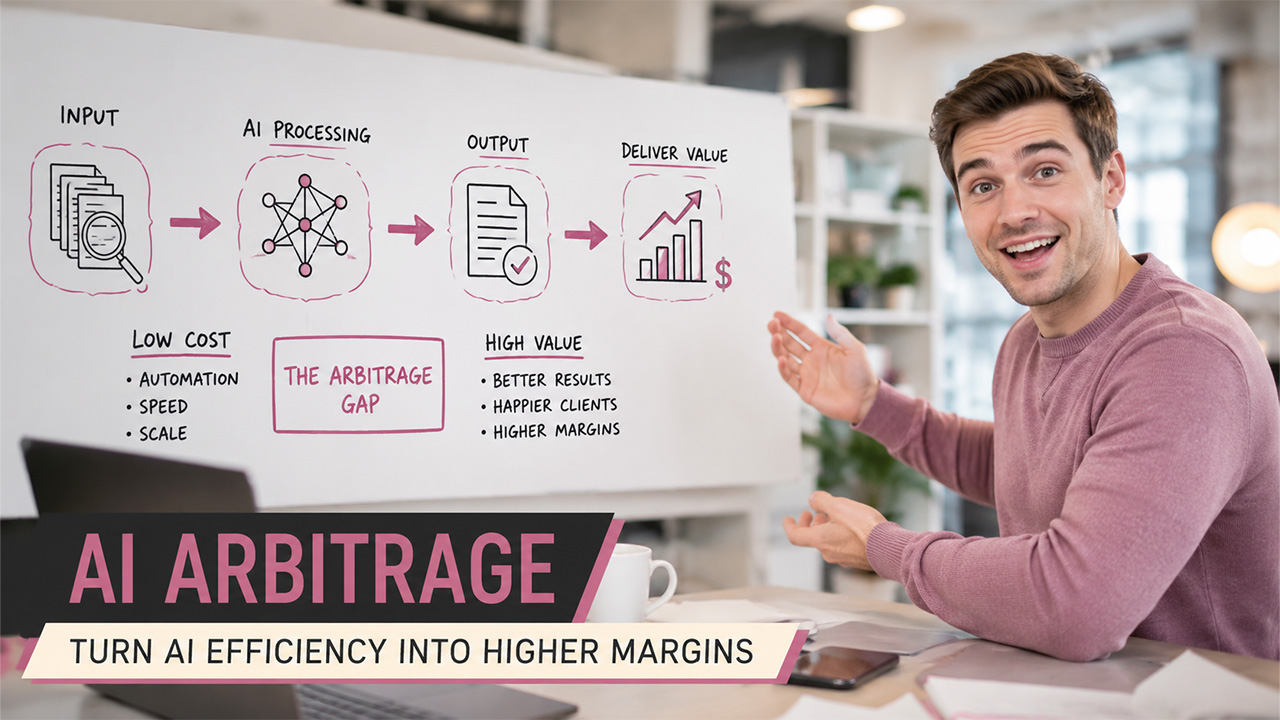
AI arbitrage is not a hidden loophole or a trading track in the market. In its ubiquitous business sense, it is using AI to deliver the same or better results with considerably less labor or time, while the price charged by the client remains associated with the outcome instead of the hours worked. The margin stems from efficiency: AI does bulk of the work on research, drafting, or implementation, and the human team emphasizes quality control, judgement, and client relationships.
To put it in simple terms:
- A client pays for an outcome — a completed trade, a piece of content, and a resolved support ticket.
- The actual cost to the provider is less after the result because AI automates the process and expedites the process.
- The main difference between the two here is arbitrage.
The term also has an older and narrower meaning in trading and finance, where AI arbitrage refers to leveraging algorithms to identify pricing inefficiencies across markets and work on them within milliseconds. Both meanings share the same core idea: AI reducing a gap more quickly than what a human would, just applied to distinct problems.
How AI Arbitrage Works?

The mechanics change slightly based on whether the context is financial trading or service delivery. However, the pattern is recognizable across both. This shift is part of a wider move toward AI-powered workplaces, where repetitive work greatly runs through automated platforms before a human can ever touch it.
In a setting involving an agency or service, the process often looks like this:
- Intake and Data: the AI system is provided with compliance rules, brand voice, and examples of acceptable output.
- Drafting and Structuring: AI creates a first version of the work including content, response, and analysis far more quickly typing from scratch.
- Human Review: A person assesses the tone, accuracy, and brand fit of the output before it goes out.
- Standardization: The same workflow gets reutilized across clients, only with light personalizable each time.
In the contexts of finance and trading, the process is comparatively mechanical and near- instantaneous:
- AI platforms consistently collect pricing information from different platforms or markets.
- Algorithms scan this data for short-lived or tiny price differences.
- Trades or transactions automatically implement this within a few seconds.
- The system improves itself over time as per which trades have worked or not.
Either way, the overall value of AI arbitrage stems from reducing the time and cost or creating an outcome without reducing the price charged for it, at least not instantly.
Where AI Arbitrage Exists?
AI arbitrage is not limited to a single industry. A few of the prevalent areas are as follows:
- SEO and Blog content systems.
- Social media scripts, captions, and ad copy variations.
- Quicker research and drafting cycles with structured quality checks.
Trading and Financial Markets:
- Cross-exchanging price differences in cryptocurrency.
- ETF pricing that varies from the value of its core assets.
- High-frequency trading strategies established on microsecond gaps in pricing.
Retail and E-commerce:
- Exploring numerous marketplaces for similar products at distinct prices.
- Automated repricing as per the demand and competitor data.
- Dropshipping models that adopt real-time pricing.
Customer Support and Processes:
- AI-generated responses reviewed by a human before sending ahead.
- Automated ticket escalation and triage.
- Internal documentation and reporting are created on a schedule.
Choosing the best model for each of the processes is important as well. A workflow created for creating content behaves very distinctly from the one created for pricing decisions, which is one reason comparing platforms like ChatGPT and Gemini is worth doing before streamlining a workflow.
Advantages and Risks to Assess

Like most efficiency-based strategies, AI arbitrage needs an assessment of genuine risks and upside that is worth taking seriously before establishing a business around it.
On the side of advantages:
- Quicker turnaround on routine work.
- Lower cost of delivery without reducing the quality necessarily.
- Capability to scale output without increasing headcount at the same rate.
On the side of risks:
- Shrinking Margins as more and more competitors adjust the similar AI tools.
- Regulatory scrutiny, specifically around exaggerated income claims and algorithmic trading.
- Ownership and copyright questions because entirely AI-generated work without any considerable human input might not qualify for protection in a few jurisdictions.
- Issues of Data Quality where delayed or inaccurate data lead to incorrect decisions.
- Dependency on technology, implies system failures or outages can convert a profitable process into an expensive one quickly.
None of this implies that the strategy cannot be implemented. It implies that the workflow requires manual checkpoints, clear criteria of evaluation, and realistic expectations about how long any given benefit will last before competitors come close. This level of oversight is more about the governance question as much as a technical one.
Conclusion
AI arbitrage mainly comes down to one core idea: leveraging AI to reduce the gap between what is the cost of something to delivery and what is the actual cost that the person is paying for it. The idea plays slightly differently in a trading algorithm chasing millisecond price gaps than it does in content teams leveraging AI to create drafts quickly. However, the core logic is the same in cases. Businesses that consider AI arbitrage as a discipline, with human review, clear workflows, and realistic risk management, tend to hold onto their benefit than the ones going after it as a shortcut.
Frequently Asked Questions (FAQs)
What is AI arbitrage in simple terms?
AI arbitrage is using AI to reduce the cost and time of delivering a result while maintaining outcome-based pricing.
What is the AI efficiency gap?
The AI efficiency gap is the difference between the value or price of an outcome and the lower cost of producing it with AI.
How does AI arbitrage work for businesses?
Businesses use AI to automate or accelerate routine tasks while human teams handle quality control, judgment, and client relationships.
What are examples of AI arbitrage?
Common examples include AI-assisted content creation, SEO research, customer support, e-commerce pricing, data analysis, and financial trading.
Is AI arbitrage profitable?
It can be profitable when AI meaningfully reduces delivery costs while businesses maintain quality, pricing power, and a clear competitive advantage.