Artificial general intelligence (AGI) remains one of the biggest topics in artificial intelligence. Researchers, technology companies, policymakers, and academics continue to debate what AGI means, how it should be measured, and how society should prepare for it.
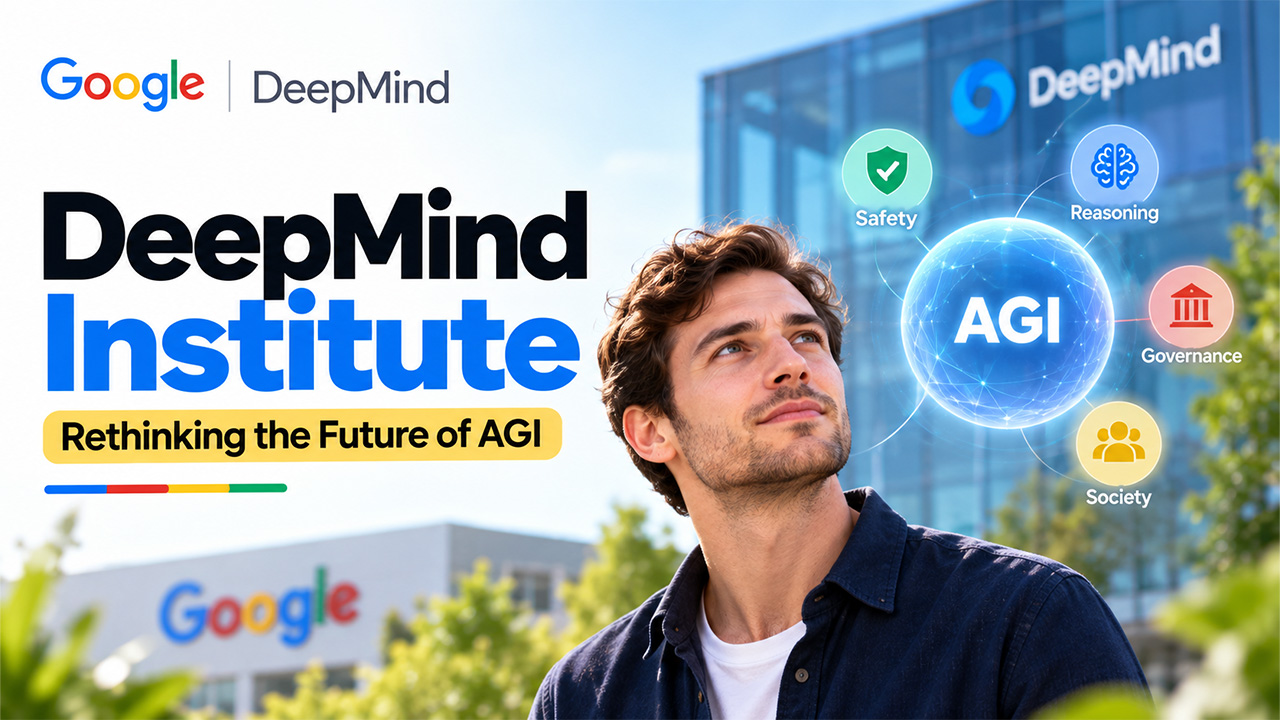
Now, Google DeepMind is creating a new platform for this discussion. Google and Google DeepMind researchers launch the DeepMind Institute, an initiative focused on expanding the conversation around AGI and bringing different perspectives into the discussion.
What Is the DeepMind Institute?
The DeepMind Institute aims to foster exploration of AGI and public debate about it. Rather than put forward a single, limited perspective about the technology, it will showcase a range of ideas from Google, Google DeepMind, and the research community.
The institute is overseen by DeepMind co-founder Shane Legg, Google executive James Manyika, and Demis Hassabis, chair of Google DeepMind. Shane Legg is also the managing editor. The institute states that the authors may hold diverse views that can evolve over time based on new research and evidence.
This provides the institute with a much broader set of responsibilities than just publishing research into AI systems. The emphasis will be on issues such as how AGI might emerge, how advanced AI is assessed, and society’s reaction to its potential impacts.
What Does the Institute Focus On?
The DeepMind Institute begins with four essays that cover different areas of the AGI debate. These topics include economic policy, AI reasoning transparency, human flourishing, and the evaluation of advanced AI models.
These subjects show that the AGI discussion goes beyond model performance. As AI systems become more capable, researchers also need to consider how governments, companies, and society respond to those capabilities.
For example, one of the initial essays examines how governments and economies can respond to potential disruption from AGI. Another looks at whether people can continue to understand how advanced AI systems reach their conclusions. The institute also examines how researchers can evaluate increasingly capable frontier AI models in a consistent way.
AI Reasoning and the Problem of Transparency

One of the institute’s first essays focuses on the transparency of AI reasoning. DeepMind safety researchers Rohin Shah and Anca Dragan argue that increasingly advanced AI systems may become harder for people to monitor.
As AI architectures become more sophisticated, developers may have less visibility into the steps a model takes while solving a problem. This creates a challenge for researchers who need to understand whether an AI system behaves as expected.
The researchers discuss a concept called “opaque serial depth,” which refers to the amount of sequential computation a model performs without producing a readable reasoning trace. They suggest that developers and regulators may need to address the safety trade-offs that come with less transparent systems. The discussion does not simply focus on making AI systems more capable. It also considers how developers can continue to monitor and evaluate those systems as their capabilities increase.
A Proposal for Frontier AI Standards
Another major proposal comes from Demis Hassabis. He proposes creating a U.S.-led standards body that evaluates advanced AI models before their release. Under the proposal, AI developers initially submit models voluntarily for evaluation up to 30 days before release. If the evaluation process proves effective, passing these tests could eventually become a requirement for deploying frontier AI models in the United States.
The proposal also includes independent evaluations. Instead of allowing AI companies to know every test in advance, the standards body could eventually use undisclosed or “held-out” tests. This approach aims to make it harder for developers to optimize models specifically for known evaluations.
Hassabis also proposes increasing the level of restrictions if the risks from frontier AI become more serious. His essay discusses the possibility of coordinated slowdowns among frontier AI developers as one potential measure.
Why Is the AGI Debate Expanding?

The launch comes at a time when discussions about advanced AI are moving toward more specific questions about safety, evaluation, governance, and disclosure. AI companies continue to develop increasingly capable models, while researchers and policymakers consider how these systems should be tested and monitored. Google DeepMind already has teams working on technical safety, governance, security, and AI risk. Its AGI Safety Council is led by Shane Legg and works with the company’s broader responsibility and safety teams.
Google DeepMind also works with external researchers and organizations on AI evaluations. In August 2026, the company announced a double-blind evaluation approach designed to reduce the effects of benchmark contamination when testing a frontier AI model. The DeepMind Institute adds another layer to this work by creating a dedicated space for broader discussion around AGI.
What the DeepMind Institute Could Add to the Conversation
The institute does not treat AGI as a single technical problem. Its initial essays cover economic disruption, human values, AI transparency, and model evaluation. That wider focus reflects the number of questions that come with increasingly capable AI. Researchers need to consider how advanced systems perform, how people monitor them, how governments evaluate them, and how society responds to their effects.
The institute also emphasizes that views can change as new evidence becomes available. This makes the AGI debate an ongoing research discussion rather than a topic with one settled answer.
As AI development continues, the DeepMind Institute gives Google DeepMind a dedicated platform for discussing these questions. Its future work may add more research and proposals to the growing conversation about what AGI means and how society prepares for increasingly capable AI systems.