
Creating an app typically involves coding, designing, database creation, testing, etc. Emergent AI reduces this process significantly by allowing users to simply describe an idea in natural language and get a functional web or mobile application. Instead of coding every line by hand, users will be able to leverage AI agents for most of the work. It’s a compelling platform for founders, developers, and anyone wanting to evaluate product ideas in a relatively limited development time. However, fast processing times do not necessarily translate to a good product; it’s about knowing what it does, how much it costs, and what is still not yet available to understand if it’s suitable for your product.
What Is Emergent AI?
Emergent AI is an application-building platform that uses AI to create applications from written input. The user describes a desired application and its capabilities, and the Emergent platform builds the application’s user interface, backend logic, and other components. Emergent employs a number of AI agents that contribute to the various aspects of building an application. These agents are responsible for assisting in planning, coding, test-flighting, debugging, and deploying, depending on the nature of the work. If Emergent is enough for the technical or coding side of your idea and now you’re worried about the design of the website. Then, you can read the guide on Stitch AI because it is made for UI design.
What Are the Major Characteristics of Emergent AI
Feature availability depends on your plan, project configuration, and integration needs. The platform provides a number of application builders, from idea to execution.
AI-powered Full-stack Development
Generate the front-end and back-end code directly from your app design. Describe everything in one brief project, the UI, the logic, the data, and more. It helps to cut down on the time needed for a project’s initial setup and wiring of simple components. The rest of the dev team can then go through the code generated and do the more technically demanding requirements.
Multi-agent Workflow
Emergent utilizes AI agents to organize various development tasks. Rather than considering the entire application as one coding task, the platform can break it into smaller steps. It’s also capable of taking a look at screenshots, detecting a handful of errors, and trying some fixes. This automated troubleshooting is useful within the early phases of growth, despite the fact that it cannot guarantee to get rid of each mistake.
Web and Mobile App Creation
It works well with web applications and mobile apps. By specifying the screens and interactions they want, you can see the experience created by the system in the preview tools. This enables teams to validate a product idea before allocating a higher budget for its full development. However, mobile app testing is yet another aspect of mobile application development that needs to be taken care of.
Code Access and Integrations
GitHub Integration gives you the ability to download and upload code for your project outside of our platform. This is important when your project extends beyond the prototype and involves developers. Deployment and a subset of third-party integrations are also available.
Emergent AI Pricing: What Does It Cost?
Pricing matters because credits are used to perform tasks with AI. The monthly cost of a subscription will not tell the whole story about what it takes to create and run your application.
| Plan | Listed Monthly Price | Listed Credits |
| Free | $0 | 10 credits |
| Standard | $20 | 100 credits |
| Pro | $200 | 750 credits |
The reference review shows the following plans. Use these figures as a guide rather than a definite cost, as plans and allowances change.
What Are the Emergent AI Benefits
Emergent is beneficial in a way comparable to other AI training platforms. Nevertheless, human effort is needed to evaluate whether the outcomes can be trusted or not.
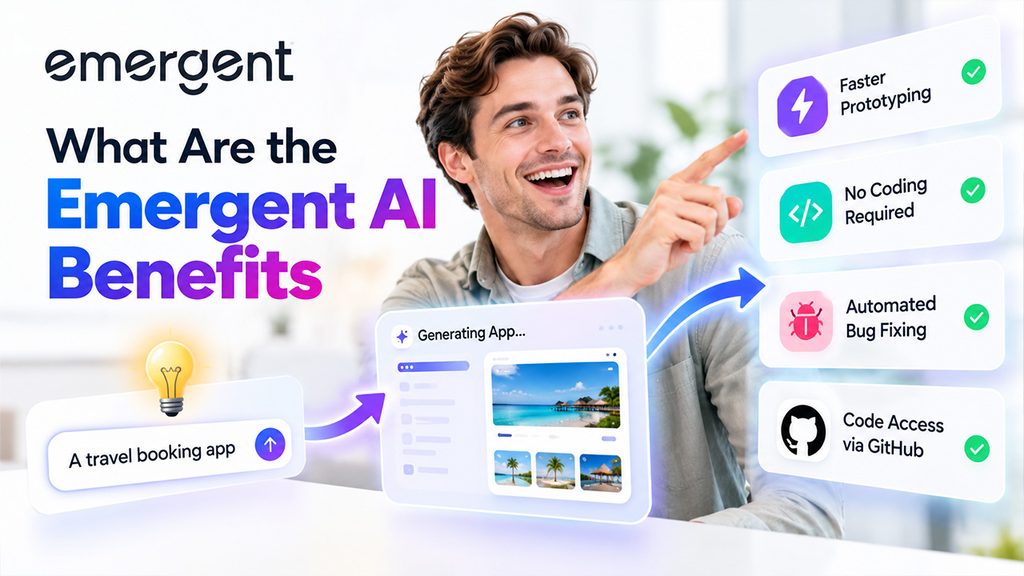
- Speedier Prototyping: Customers flesh out their concept and get to market without having to invent each and every component. This allows founders to test their assumptions before committing to a full engineering build.
- Reducing Technical Barriers: Programming language knowledge is no longer necessary for creating simple applications through the use of natural-language programming commands. Developers can use the system to accelerate execution of repetitive implementation tasks.
- Automated Bug Fixing: An AI agent might identify specific bugs and attempt to fix them as they occur. This could reduce time spent fixing bugs, especially early in development.
- Code Access: GitHub integrations enable code to be accessed, and development teams to continue coding off the platform.
What Are the Weaknesses of Emergent AI
The takeaway is that the platform might save you some development work, but not in terms of how it shifts your quality, security, or support issues.
- Design Quality Needs Work: A prototype screen works, but it often has positioning issues, similar templates, irregular spacing, or poor hierarchy. Design-driven products still need extra effort.
- More Credits Get Used: Generating new images with multiple prompts, iterating, or making major changes uses more credits. Users watch their usage instead of assuming every revision costs the same.
- Testing Is Still Required: Automation does not replace security testing, accessibility testing, performance testing, or validation of business logic.
- Advanced Development Is Sometimes Necessary: Complex integrations, non-standard workflows, database changes, and production environments often require a more experienced developer.
Who Should Use Emergent AI?
This is where the value of this platform becomes clear. When a person is looking to create a prototype of an idea, they are really looking to create a working prototype in a short amount of time.
- Startup Founders
It’s great for founders to create an MVP and gather pre-market signals ahead of getting a team of engineers on board. For example, you may use it to test a booking flow or customer portal on a few users.
- Product Managers
Product managers could also build working prototypes to communicate needs more easily. Usually, an interactive prototype can be easier to understand for stakeholders than a document describing the feature.
- Freelancers and Developers
A freelancer might be able to use AI-generated code to reduce the time on the first build and ease the tedium of scaffolding dependencies. The developer could critique the architecture, refine the implementation, and add project-specific features.
- Non-technical Entrepreneurs
You don’t need to learn a complete developer stack to write simple business apps. However, you must learn what is minimally necessary for your application and be able to access developer support when it’s needed.
Conclusion
Emergent AI provides a clear path from application concept to a working prototype through natural-language prompts and AI-assisted development. Its full-stack capabilities, automatic troubleshooting, and code access can help founders, product managers, and developers iterate more quickly during the early stages. For projects that require Custom Web Development, the platform can also serve as a starting point for building and testing application ideas. However, applications still need thorough quality testing, thoughtful design, and security audits before production use. Credit consumption is another factor to consider, especially when repeated revisions are required. It is best to start with a small project, test the platform against your requirements, and calculate the overall cost before moving to production.
FAQs :
What is Emergent AI used for?
Emergent AI helps users create web applications, mobile apps, and prototypes through natural-language prompts. It can generate code and assist with testing and deployment.
Is Emergent AI free?
It offers a limited free tier. The available credits may not cover a complete application, so check the official pricing page for current limits.
Does Emergent AI require coding skills?
No advanced coding skills are necessary to get started. However, technical knowledge helps with debugging, security, integration, and complex changes.
Can Emergent AI build production-ready apps?
It can generate functional applications, but production readiness depends on testing, security, performance, and the project’s specific requirements.