Introduction
Our workplaces have drastically changed. And, Artificial Intelligence has played a major role in driving this transformation. The exponential growth of AI-driven workplaces has modified how tasks get done, how we make decisions, and how teams work on a day-to-day basis. From generative platforms that create content in a few seconds to smart assistants that handle the complete workflows, AI has gone from being experimental add-on to the main part of routine operations. Thus, the same question is being asked across industries and businesses: what is the future of AI-powered workplaces? Essentially, businesses must know how they can prepare for the AI-driven future workplaces.
In this blog, let us break down what AI-driven workplace means really, the technologies that drive this shift, and the possible steps businesses can take to remain ahead of the game.
What Is an AI-Powered Workplace?
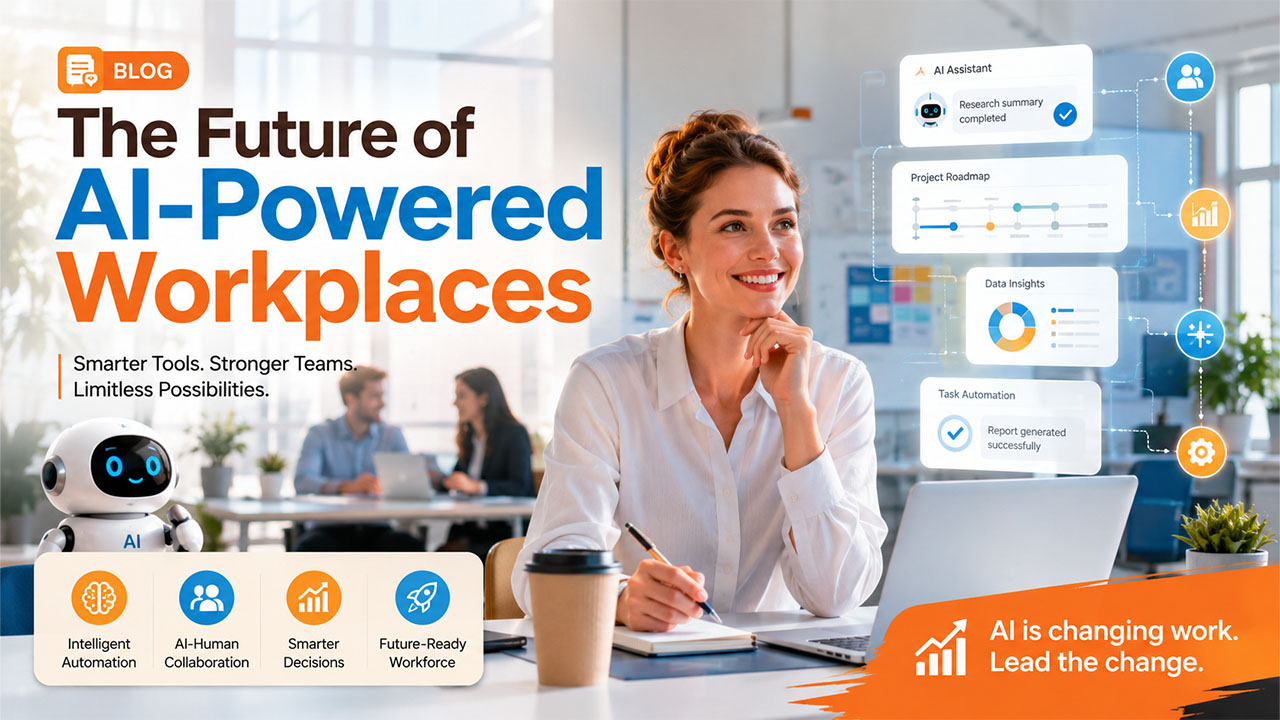
An AI-powered workplace refers to a work environment where AI tools are directly woven into routine processes, not considered as an individual system employees use occasionally. This involves:
- Generative AI tools like Claude AI that create code, content, and reports.
- AI assistants built-into productivity software for fast decision support.
- Agentic AI systems that finish tasks that require multiple steps with minimum supervision.
- Data-based platforms tailor employee experiences and reveal insights that leaders can otherwise miss.
Instead of replacing human judgement, such systems are specialized to work alongside other people, managing routine or data-heavy tasks so employees can spend their time and effort on creativity, strategy, and building relationships. As a result, we get a workplace where AI-driven collaboration becomes a vital part of the planning and execution of the work.
Important Technologies Transforming AI-driven Workplaces
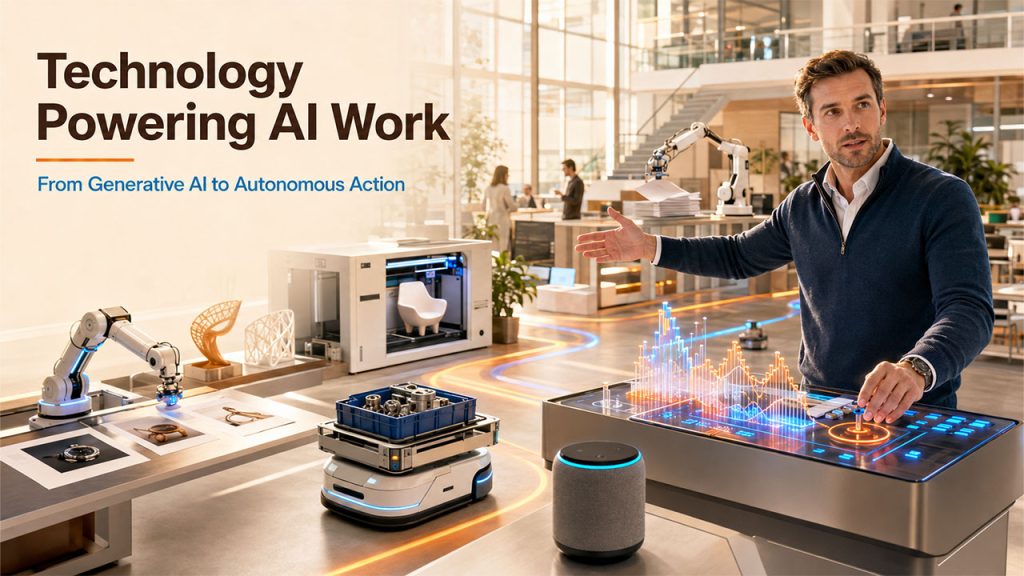
A handful of vital technologies are pushing this transformation. Being familiar with them aids in clarifying why AI-driven workplaces are becoming the standard instead of exception:
- Generative AI : Developed on LLM modes, such tools create code, text, and visual content, and greatly combine image, text, audio, and video capabilities in a single environment. Some businesses go for general-purpose AI tool while others go for multimodal platforms like Gemini. To know how they compare with one another, explore our detailed guide on ChatGPT Vs Gemini.
- AI assistants: Generally embedded in routine software, such tools respond to requests in natural language and provide support to quicker decision-making across different departments.
- Agentic AI: Contrary to basic chatbots, autonomous AI agents can retain their memory, extract external data sources, and implement multi-step or complex processes with limited oversight of humans.
- Predictive analytics : Leveraged to predict demand, highlight risks, and recognize patterns across huge datasets can be difficult for a person to manually catch.
Combined, such tools are converting static workflows into adaptive platforms, one of the clear signals of a complete AI-powered workplace.
How AI Is Changing Skills, Roles, and Workflows?
The shift toward AI-powered workplaces is transforming not just how the tasks are being finished, but which skills are most important. A few stand out trends are as follows:
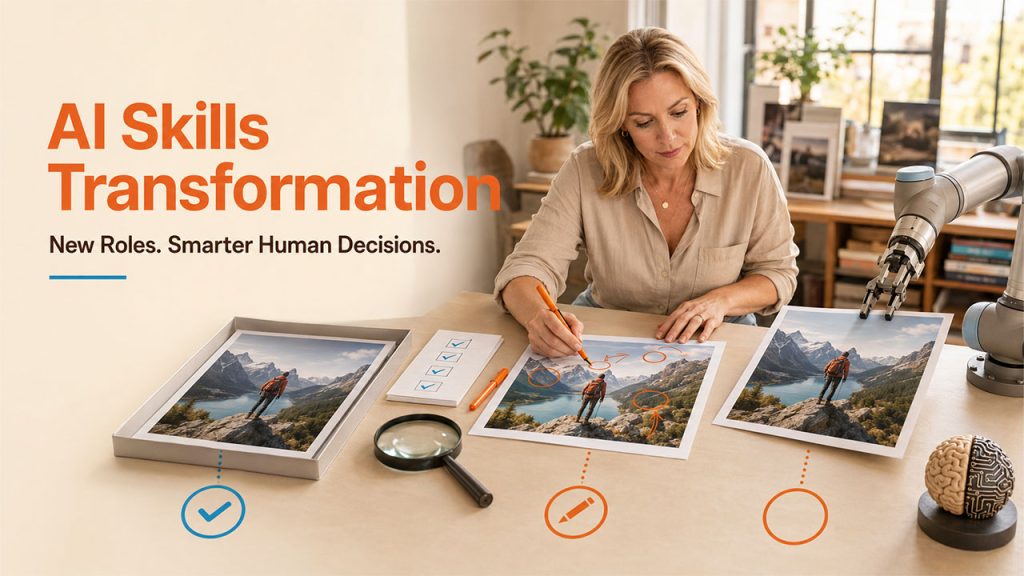
From Creation to Editing :
Employees are now spending their time refining, reviewing, and improving AI-generated output instead of developing everything from basics, emphasizing human evaluation and contextual judgement. One great example of this is content creation. To know how AI writing tools have changed content generation, check out our detailed guide.
New Categories of Job :
Roles emphasized AI oversight, prompting, and workflow design are emerging, even as a few basic analysis-based and data-entry tasks decline.
Increasing Demand for Human Skills:
Empathy, creativity, systems thinking, and ethical reasoning are emerging operational needs instead of “soft” extras, since AI still relies on human judgement for accountability and context.
Much More Clear Review Structures :
Because AI outputs require validation, teams are developing pre-defined checkpoints for who will review the output, how errors can be caught, and where human sign-off remains vital.
Curiously, while AI workflow automation is changing workplaces around the world, what employees emphasize at work has stayed stable. Career growth, flexibility, supportive leadership, and fair recognition continue to be the main reasons people leave or stay in the role, even inside a quickly evolving AI-driven workplace.
Talent and Leadership Strategies for the Artificial Intelligence Era
Developing a sustainable AI-driven workplace needs more than adjusting to new platforms. It calls for deliberate leadership decisions :
Organizations that consider this an ongoing transformation, instead of a one-time rollout, are more effectively positioned to benefit from human-AI and workplace automation without forgetting about human dependence. If need insights and tips on how you can implement AI in your business, you can check out our detailed guide.
Establish Clear Governance from the Beginning :
Leaders must define which decisions need a human-sign off, which tasks you can automate, and how outputs get audited over time
Investment in Development of Workforce :
Applied experimentation, upskilling programs, and organized coaching enable employees to each level creates practical AI fluency instead of surface-level familiarity.
Secure leadership fundamentals :
As AI transforms roles, employees greatly expect supportive management, clear communication, and transparency about why and how AI is being introduced.
Notice Retention Risk Among Advanced Users of AI :
Employees who leverage AI most greatly report better levels of engagement, but also the best intent to explore better opportunities, making personalized retention strategies significant.
Develop Strong Data Foundations :
Well-governed and reliable data is what enables AI tools to create explainable, accurate, and trustworthy outputs across the business.
Organizations that consider this an ongoing transformation, instead of a one-time rollout, are more effectively positioned to benefit from human-AI and workplace automation without forgetting about human dependence. If need insights and tips on how you can implement AI in your business, you can check out our detailed guide.
Frequently Asked Questions :
Q1. Is full automation comparable to AI-driven workplace?
No. Most AI-driven workplaces integrate automation for routine tasks with greater human oversight for decisions that require human judgement, instead of entirely removing the people from process.
Q2. What skills are most important in an AI-driven workplace?
Communication, creative problem-solving, the capability to direct and evaluate AI output, and ethical judgement tend to be more important than repetitive technical execution alone.
Q3. Do AI-driven workplaces minimize entry-level opportunities?
A few businesses have reported less demand for specific entry-level tasks as automation expands, which makes mentorship and early-career development significantly more important, not less.
Q. How can a business begin developing an AI-driven workplace?
Most businesses start by mapping which workplaces benefit the most from AI support, invest in better data quality, and developing baseline AI literacy across teams before further scaling.
Conclusion
The future of AI-powered workplaces will be less shaped by the technology itself and more by how carefully businesses integrate. The tools, from generative Artificial Intelligence to autonomous agents, are already capable of changing how the work gets completed. What essentially separates resilient businesses from the rest is leadership: ongoing skill-building, clear governance, and genuine commitment to keeping people at the focus of the AI-driven decisions. Businesses that ensure this balance right will not just adapt to the future of work; they will define it.
As workplaces are increasingly adopting Artificial Intelligence across the board, it is critical to know what top AI trends to watch in 2026.