Google launches Gemini 4 Argon, its latest frontier AI model, with a focus on complex coding, enterprise work, research, and cybersecurity. Announced on September 30, 2026, Argon is designed to handle long, multi-step tasks that require sustained reasoning rather than short responses. Google says the model is already being used internally by thousands of employees for software engineering, research, and other specialized work. The company initially limits access to trusted cyber defenders through its Fairwind Program as it continues testing the model’s safety systems before a wider release.
Gemini 4 Argon Focuses on Long-Horizon Tasks
Google positions Gemini 4 Argon as a model built for problems that require multiple steps and extended reasoning. One of its major technical changes is a 1 million-token output limit, which is significantly higher than the previous 64,000-token limit Google cites. This allows the model to work through longer tasks and produce much larger outputs in a single process.
The model targets real-world software engineering, enterprise knowledge work, legal and financial research, and other professional workflows. Google says Argon achieves a 77.9% score on DeepSWE v1.1, a benchmark for long-horizon software engineering tasks. It also ranks first on Zapier’s AutomationBench with a score of 51.3%, according to the company.
Google Uses Argon Across Its Own Workflows
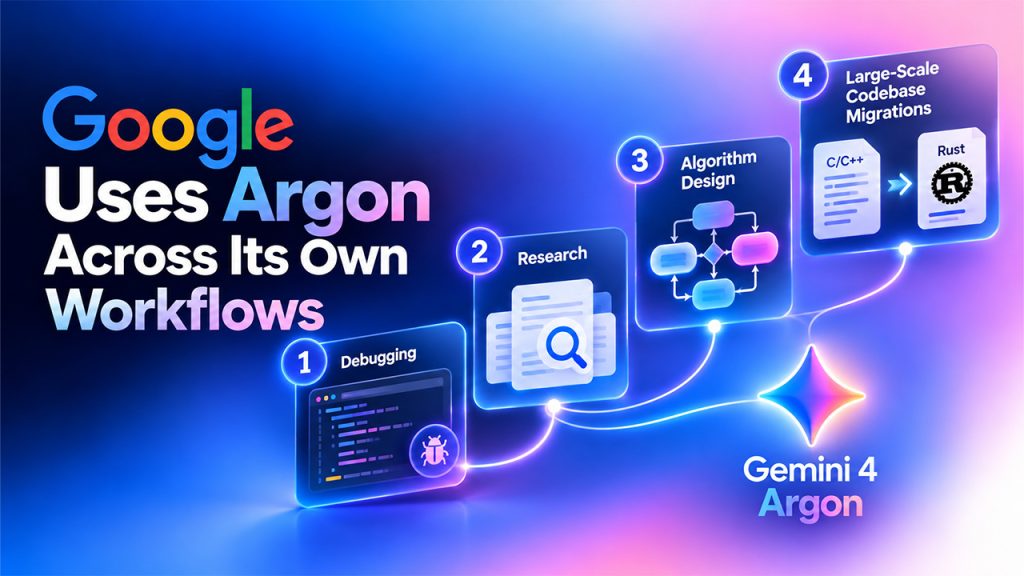
Google says Gemini 4 Argon is already supporting internal teams across the company. Thousands of Googlers use the model for tasks such as debugging, research, algorithm design, and large-scale codebase migrations. One example involves Google’s work to migrate C and C++ codebases to Rust. According to Google, Argon agents work across projects ranging from tens of thousands of lines of code to more than 800,000 lines in the Fuchsia Zircon kernel. These migrations still go through automated and manual audits, testing, and review before production use.
Google also reports that Argon helps its quantum computing researchers optimize algorithms. In one example, the company says the model beats a published baseline by 40% within minutes. Another internal project uses Argon to identify memory optimization opportunities across Google’s AI data centers, with Google estimating more than 300 TiB of memory can be freed once the changes roll out.
Gemini 4 Argon Targets Cybersecurity Defense
Cybersecurity is one of the central areas of the new model. Google specifically trains Argon for defensive cybersecurity work and says it can autonomously find, validate, and patch critical software vulnerabilities. The company initially releases the model to selected cyber defenders through its Fairwind Program. Google says trusted defenders and its internal teams receive access without cyber guardrails so they can use its full cybersecurity capabilities.
Google also reports that Argon ties for first place on CWE-bench v1 with a score of 68%, a benchmark that evaluates vulnerability remediation. In an early demonstration, Google says the model identifies a critical vulnerability in healthcare software that exposes sensitive personal information.
Google Highlights Multimodal and Enterprise Capabilities
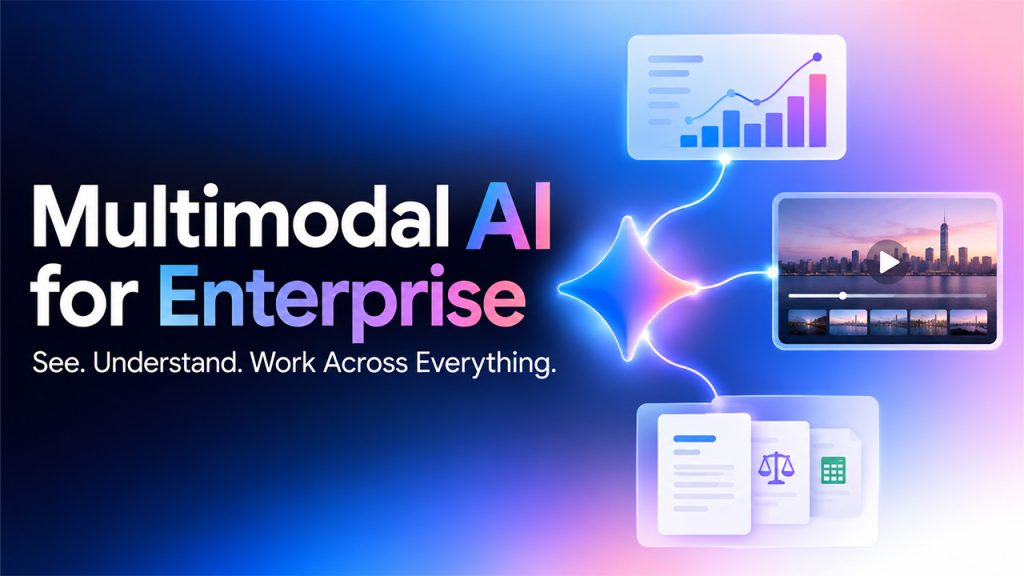
Beyond coding and cybersecurity, Gemini 4 Argon handles visual information as part of longer professional workflows. Google says the model can analyze charts, understand long videos, and work with information spread across multiple documents. It reports a 91.7% score on LVBench, a benchmark for long-video understanding.
The company also says Argon performs strongly across finance, legal, and tax-related evaluations. On the Vals Index, which measures economic impact across professional knowledge work, Google says Argon ranks as the leading model. These results are company-reported benchmarks, so independent evaluations will provide additional context as access expands.
Argon Starts With Limited Access and New Pricing
Google takes a phased approach to the Gemini 4 Argon launch because of the model’s capabilities. The company says it continues strengthening safeguards against cyber misuse, CBRN-related misuse, prompt injection attacks, and potential model misalignment before expanding access.
For its initial API availability, Google sets introductory pricing at $2 per million input tokens and $10 per million output tokens. The pricing of advanced AI models is also closely connected to the hardware that supports them, making AI chips news relevant to the broader AI infrastructure discussion. Cached input tokens receive a 95% discount from the input price. After the introductory period, pricing increases to $4 per million input tokens and $20 per million output tokens. Google plans to expand Gemini 4 Argon to developers, enterprises, and consumers, starting with paid API customers and Google AI Ultra subscribers. For now, the model remains limited while Google gathers feedback from trusted testers and continues refining its safeguards.