AI agents are now smart enough to handle complex tasks, however, it costs many and time to run them constantly, at scale. Google’s latest release tackles exactly that, not by chasing bigger benchmark numbers, but by making its models leaner, faster, and cheaper to actually run.
The update brings three new models, each solving a different piece of the puzzle:
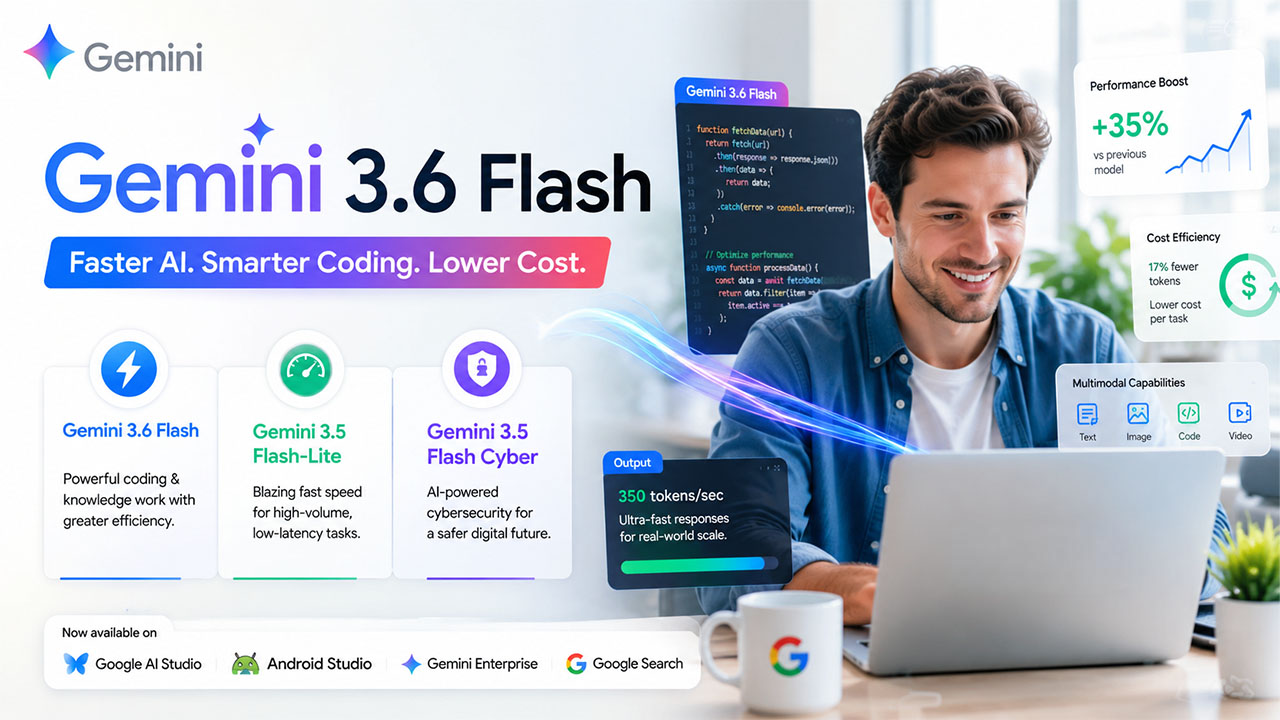
- Gemini 3.6 Flash — the core workhorse, built for coding and knowledge work
- Gemini 3.5 Flash-Lite — the speed specialist, made for high-volume, low-latency tasks
- Gemini 3.5 Flash Cyber — a narrow, security-focused model with restricted access
What Has Changed?
Google’s latest AI updates doesn’t just focus on improving efficiency, it increases model size too. Instead of releasing one general-purpose model, Google has introduced three specialized Gemini models, each designed for a specific use case; from advanced coding and knowledge work to high-speed processing and AI-powered cybersecurity. The goal is to deliver better performance while reducing costs and latency.
Let’s take a closer look at what each new Gemini model offers and where it fits in Google’s evolving AI ecosystem.
Gemini 3.6 Flash: Faster Performance with Greater Efficiency

Gemini 3.6 Flash builds on 3.5 Flash, and it does not just improve performance, rather boosts efficiency, too. According to the Artificial Analysis Index, it uses 17% fewer output tokens than its predecessor. Fewer tokens means you need fewer reasoning steps and tool calls to finish the same job, which translates directly into lower cost per task.
The model improves coding precision, without having to make too much unwanted edits. It’s marks a solid shift in machine learning research benchmarks. Its computer-use capabilities allow it to directly interact with software interfaces. On top of that, this feature now comes built-in through the Gemini API and Gemini Enterprise. Many companies that work with document parsing and report drafting have already tried it and reported strong results in practice.
It addresses safety concerns, too. 3.6 Flash comes with stronger protections against chemical, biological, radiological, and nuclear misuse, along with cyber offense risks, making it harder to jailbreak. Google says it balanced this with fewer unnecessary refusals for legitimate use, a tricky line to walk.
Gemini 3.5 Flash-Lite: Optimized for Speed and Cost Efficiency
If 3.6 Flash is the reliable all-rounder, 3.5 Flash-Lite is built purely for speed. It’s the fastest model in the 3.5 lineup, running at 350 output tokens per second, and it’s priced well below 3.6 Flash. That makes it a strong fit for high-throughput jobs like agentic search or bulk document processing, where latency and cost matter more than raw depth.
Gemini 3.5 Flash Cyber: Purpose-Built for AI-Powered Cybersecurity
The third release takes a different path entirely. Gemini 3.5 Flash Cyber is fine-tuned specifically to detect, verify, and fix software vulnerabilities. It works inside CodeMender, which is a Google’s dedicated code security agent. However, this kind of tool could just as easily help attackers as defenders, that’s why Google is rolling it out through a limited pilot. For now, it is only available to governments and trusted partners.
What’s Next for Google’s Gemini AI Models?
This is not where this release ends. Gemini 3.5 Pro is already being tested with select partners and will roll out more widely once it’s ready. Google has also confirmed it’s begun training Gemini 4, its next major model, which says a lot about how fast this space keeps moving. With so much changing, many people are also comparing ChatGPT vs Gemini to see which one fits their needs better.
For now, developers can start using 3.6 Flash and 3.5 Flash-Lite through Google AI Studio, Android Studio, and Gemini Enterprise, with Flash-Lite also making its way into Google Search itself.
Frequently Asked Questions (FAQs)
Q. What is Gemini 3.6 Flash used for?
It’s Google’s core workhorse model, built for stronger coding, knowledge work, and multimodal tasks at a lower cost per output token.
Q. How is Gemini 3.5 Flash-Lite different from 3.6 Flash?
It’s optimized purely for speed and cost, making it ideal for high-volume, low-latency tasks rather than deep reasoning work.
Q. Who can access Gemini 3.5 Flash Cyber?
It’s currently limited to governments and trusted partners through a pilot program within Google’s CodeMender security agent.
Q. Is Gemini 3.5 Pro available yet?
Not broadly, it’s currently being tested with select partners and will roll out more widely once it’s ready.
Q. Where can developers start using these new models?
Through Google AI Studio, Android Studio, and Gemini Enterprise, with Flash-Lite also rolling out in Google Search.