
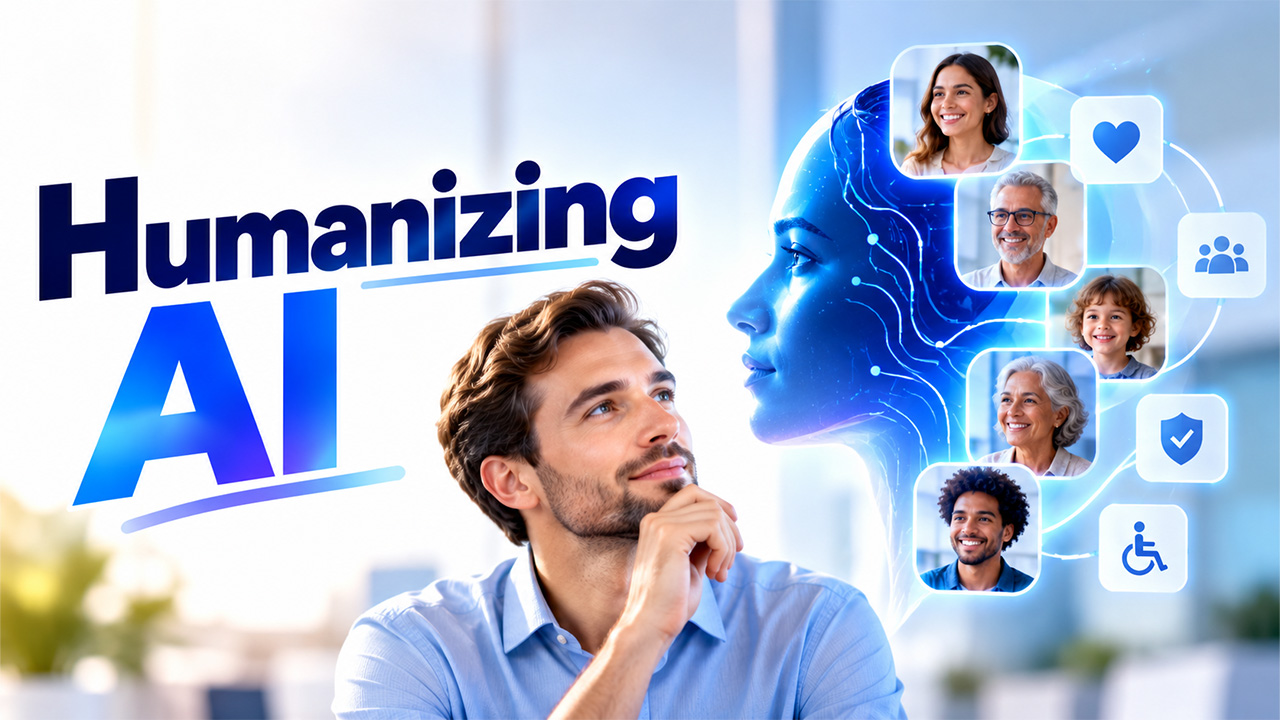
The article explores what humanizing AI means, why human-centered design matters, its key principles, and how businesses can use this approach to create more responsible and effective AI solutions.
The adoption of artificial intelligence has changed how employees and individual consumers perform tasks, speak with others, acquire knowledge, purchase goods, and use electronic devices. AI is now a common element in daily activities because it provides vocal aids, conversational software, specific suggestions plus programmed help for buyers – but researchers now ask whether engineers build those advanced systems to prioritize the hardware or to prioritize the users.
To humanize AI is to create software that identifies what users require, honors the way each individual differs, speaks in a way that is easy to follow, and assists the users in what they do. It is more than the act of refining mathematical formulas or making more tasks run without intervention. It is the process of making AI tools that are easy for everyone to reach, that users can rely upon, that show how they function, and that match the principles that users hold.
By using human-centered design, developers achieve this goal – organizations are able to make AI interactions that seem more like standard behavior but also provide more utility. They do this when they give more importance to the requirements, goals, feelings, and physical or mental boundaries of the specific individuals who use the software.
What is Humanizing AI?
Humanizing AI is the process of designing and developing artificial intelligence systems that can understand human needs, communicate naturally, and provide helpful, inclusive, and trustworthy experiences. The process focuses on making AI more user-friendly, transparent, and aligned with human values.
The platform keeps people at the center of technology, rather than concentrating only on automation, speed, or technical performance. It also ensures that AI systems are designed to solve crucial real-world challenges, while also respecting users’ privacy, emotions, individual differences, and decision-making.
Key Features of Humanizing AI
It combines advanced technology with human-centered design to ensure AI systems meet people’s needs while respecting their values, privacy, and decisions.
Some of the key features of Humanizing AI are as follows:
- Empathy and Emotional Awareness: The system can use contextual clues and language patterns to adjust their responses and are able to communicate more considerably.
- Personalization: Personalization allows AI systems to adapt their recommendations, responses, and services to individual preferences and needs.
- Transparency and Explainability: A transparent AI system can communicate its capabilities, limitations, and uncertainty, instead of presenting every answer as unquestionably correct.
- Accessibility and Inclusivity: The system combines features such as voice interaction, screen-reader compatibility, multilingual support, captions, and simple interfaces to help make AI accessible to a wider range of users.
Key Benefits

It provides many advantages across organizations, consumers, and society. It allows businesses to realize value from their use of technology while protecting human interests.
Some of the key benefits of humanizing AI are as follows:
Improves User Experience
One significant advantage of humanising AI applications is a more delightful and pleasant living experience. The AI can perceive the needs of its clients and respond appropriately. In this way, we find AI applications more open and charming to utilise.
Gains Confidence and Trust
People are more likely to use an AI tool when they understand it, get honest answers, and feel assured their data will be treated ethically.
Businesses must also establish clear accountability and oversight to ensure responsible AI adoption. Learn more about why AI transformation depends on governance, not just technology.
Enhance Personalization
Humanising AI allows organisations to offer the most personalised experiences, highly targeted to users’ likes, behavior, and needs.
Supports Better Decision-Making
It has the ability to process large quantities of data and search for trends, then give insightful suggestions. When used with human intelligence, it is capable of improving the quality of decision-making.
How Do Businesses Implement Humanizing AI?
The process through which businesses can implement humanizing artificial intelligence are as follows:
- Step 1: Identify a Meaningful Problem
Start by determining where AI can address an existing challenge. Avoid introducing AI simply because it is a popular technology trend.
- Step 2: Involve Users Early
Include customers, employees, and other relevant stakeholders in the research and design process. Their feedback can help identify usability problems and overlooked requirements.
- Step 3: Develop and Test Prototypes
Create early versions of the AI experience and test them with representative users. Observe where people become confused, lose confidence, or struggle to complete tasks.
- Step 4: Establish Ethical Safeguards
Assess privacy, security, fairness, accessibility, and potential risks before launching the system. Define responsibilities for monitoring and addressing problems.
- Step 5: Measure Outcomes that Matter
Evaluate more than technical accuracy. Consider user satisfaction, task completion, accessibility, error recovery, trust, and the frequency of unnecessary escalations.
- Step 6: Collect Feedback and Iterate
Provide accessible feedback channels and use the information to improve the experience. Make it clear how users can report errors or request assistance.
Real-World Applications
It ensures that technology supports people in their everyday activities while preserving human judgement, trust, and control, instead of focusing only on automation.
Some of the key real-world applications of human-centered AI are as follows:
Education
Humanizing AI in the education sector makes learning more flexible and responsive to individual students. AI-powered educational tools can help accommodate these differences.
Healthcare
In the healthcare sector, humanizing artificial intelligence helps make medical services more accessible, understandable, and responsive to individual patient needs. The tool can assist with symptom information, appointment scheduling, patient communication, and administrative tasks.
Customer Service
Humanizing artificial intelligence offers the most visible application in customer service. AI-powered chatbots and virtual assistants can answer common questions, track orders, explain services, and help customers resolve routine problems.
Businesses exploring conversational AI can also compare AI chatbot alternatives for work and productivity to understand which solutions best match their customer support and operational needs.
Banking and Financial
In the finance and banking sector, humanizing artificial intelligence can help make the service more accessible by explaining information in simple language and helping users complete everyday tasks.
E-Commerce
In the e-commerce section, humanizing artificial intelligence enables businesses to understand shopping preferences and make online shopping more convenient. AI-powered recommendation systems can suggest products based on browsing activity, stated preferences, and previous purchases.
Key benefits:
- Provides relevant product recommendations.
- Simplifies product discovery and comparison.
- Helps customers make informed purchasing decisions.
Challenges in Humanizing AI
Although humanizing artificial intelligence involves making artificial intelligence more helpful, it also includes several challenges, which include:
- Understanding Human Emotions: AI may struggle to understand emotions, sarcasm, tone, and context, which can lead to inappropriate or irrelevant responses.
- Maintaining Trust and Transparency: Users may find it difficult to trust AI when its decisions are unclear, or its answers are inaccurate.
- Protecting User Privacy: AI systems often process personal data, creating concerns about data security, consent, and unauthorized use.
Conclusion
Humanizing AI is essential for creating technology that prioritizes human needs, values, and experiences. By adopting human-centered design, enabling business development AI solutions that are more accessible, trustworthy, personalized, and effective. Ultimately, the goal of humanizing artificial intelligence is not just to build smarter systems but to create meaningful experiences that empower people and ensure technology works for humanity.
Frequently Asked Questions :
What is human-centered AI design?
Human-centered AI design is an approach to developing AI systems that prioritizes users’ needs, preferences, experiences, and limitations throughout the design and development process.
What are the key principles of human-centered AI design?
The key principles include transparency, fairness, privacy, accessibility, empathy, reliability, human oversight, usability, and continuous improvement based on user feedback.
How does humanizing AI build customer trust?
Humanizing AI builds customer trust by communicating clearly, acknowledging limitations, protecting personal information, providing reliable assistance, and offering access to human support when needed.
How does humanizing AI improve personalization?
Humanizing AI uses relevant information about user preferences and needs to provide tailored recommendations, responses, and services.