
Artificial intelligence (AI) is changing the way we work, learn, communicate, and use technology. From virtual assistants and chatbots to self-driving cars and sophisticated healthcare systems, AI is fast emerging as a vital aspect of modern life. However, have you ever wondered what makes such smart systems work efficiently? The answer exists in a combination of robust software specialized computing components like AI hardware.
Being familiar with AI hardware is significant for anyone who is interested in AI, computer technology, or future innovation. In this complete beginner’s guide, let us understand what AI hardware is, how it operates, its distinct types, its advantages, and why it is important in quickly evolving AI industry-
Also Read: Artificial Intelligence: A Complete Guide
What Is AI Hardware?
AI hardware are the physical components as well as the computing devices designed specifically or optimized to perform AI tasks. Such tasks include training ML models, processing big datasets, identifying images, comprehending human language, and creating forecasts.
Contrary to conventional computer hardware, which is specialized in managing a broad range of tasks, AI hardware typically emphasizes in performing mathematical operations needed by AI algorithms in a fast and efficient way.
Advantages of AI Hardware
AI hardware plays a significant role in making AI quicker, more practical, and more accessible.
Here are a few of its more key advantages:
- Quicker AI Processing: Specialized processors can implement AI calculations much more quickly than hardware that is not optimized for such workloads.
- Enhanced Energy Efficiency: Efficient AI chips can minimize the energy needed for specific computations, although precise savings rely on the workload and system design.
- Larger Models Support: High-bandwidth memory, powerful processors, and quick interconnects aid platforms in improving complex AI models.
- Real-time Performance: AI hardware can provide support to applications that need fast responses, like driver-assistance platforms, robotics, and interactive voice assistants.
Types of AI Hardware
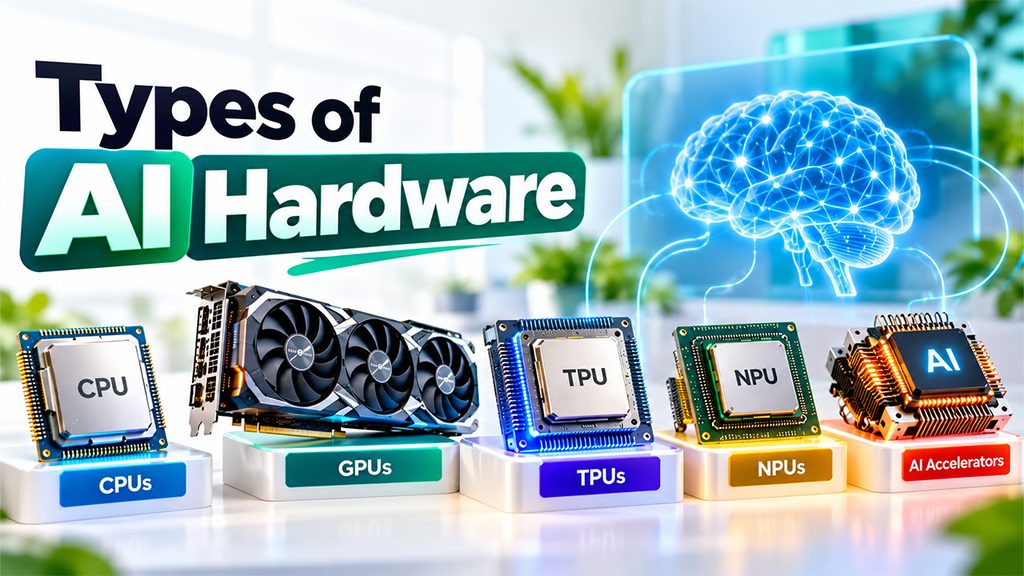
Distinct AI apps need various types of computing hardware. A few devices are created for general computing, while others are optimized for particular AI workloads.
Central Processing Units (CPUs)
A CPU, i.e., a central processing unit, is the main processor that are found in laptops, computers, and servers. It manages general-purpose computing tasks and can also run different AI apps.
Graphics Processing Units (GPUs)
GPUs, Graphics processing units are among the most broadly utilized components in advanced AI computing. Developed to render graphics originally, GPUs are specifically effective at performing different mathematical operations simultaneously.
GPUs are also essential for many teams working with self-hosted language models, where hardware selection can influence model training, deployment, and operating costs. Learn more in our guide to open-source LLMs and self-hosting.
Tensor Processing Units (TPUs)
TPUs, Tensor Processing Units, are powerful processors built to expedite machine learning calculations, specifically tensor operations utilized in neural networks.
Neural Processing Units (NPUs)
NPUs, short for Neural Processing Units, are purpose-built processors to expedite neural network processes. They are extensively appearing in laptops, smartphones, and other consuming devices.
AI Accelerators and Specialized Chips
AI accelerators are purpose-built hardware components built to expedite specific AI workloads. They include architectures and chips specialized for effective machine learning computation.
How Does AI Hardware Work?
AI systems rely on mathematical calculations to identify patterns, learn from data, and generate useful outputs. AI hardware accelerates these calculations so that complex models can operate more efficiently.
The process generally involves three important stages.
Step 1: Data Processing
AI systems receive information such as text, images, audio, or numerical data. The hardware processes this information and prepares it for computation.
Step 2: Model Training or Inference
During training, AI models learn patterns from large datasets by repeatedly performing calculations and adjusting their internal parameters. During inference, a trained model uses what it has learned to produce predictions, classifications, or responses.
Step 3: Output Generation
Real World Applications of AI Hardware
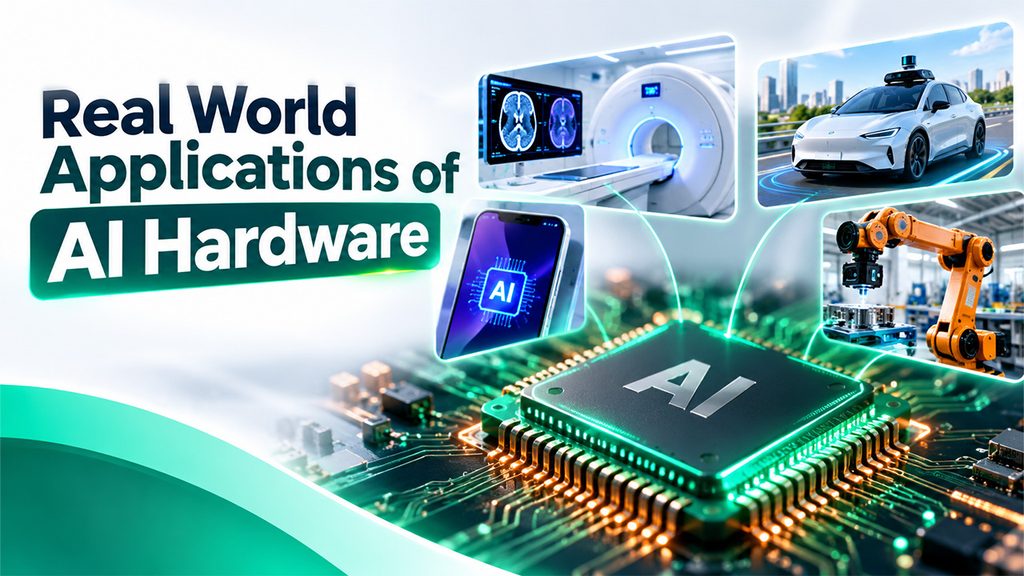
AI hardware is commonly utilized across many products and industries, which includes the following:
Healthcare
In the healthcare and research organization, AI-enabled computing systems are typically utilized to assist with medical image analysis, scientific research, and other data-intensive tasks.
Smartphones and Personal Computers
In modern smartphones and personal computers, AI accelerations are integrated heavily. These accelerations can support key capabilities, such as speech recognition, photo editing, translation, video effects, and other intelligent features.
Autonomous Vehicles and Robotics
Various types of specialized processors are utilized in autonomous vehicles and robotics to analyze sensor data, recognize objects, and make decision withing strict time requirements.
Data Centers and Cloud Computing
Cloud providers like data centers and cloud computing operators users AI servers equipped with powerful processors, high-speed memory, and networking equipment to train and operate AI models at scale.
Manufacturing and Industry
Manufacturers utilize AI systems for visual inspection, predictive maintenance, process optimization, and robotics. AI hardware helps process operational data and support timely decisions.
Challenges in AI Hardware Development
Although AI hardware offers key benefits, it also included various challenges, such as:
- High Costs: Advanced processors and AI servers usually require substantial investment, especially for large-scale model training.
- Power Consumption: Operating a large AI workload can consume significant amounts of electricity, along with generating heat, increasing cooling and infrastructure requirements.
- Memory Limitations: Modern AI models need fast access to large amounts of data. Memory capacity and bandwidth can become major performance bottlenecks.
- Rapid Technological Change: Hardware architectures and AI software are evolving quickly, making it difficult for organizations to choose solutions that remain suitable over time.
Beyond technical challenges, businesses must also consider how AI systems are managed, monitored, and deployed responsibly. Establishing clear accountability, risk controls, and oversight is essential for successful implementation. Learn more about why AI governance and responsible AI adoption are critical to successful AI transformation.
Conclusion
AI hardware refers to the physical foundation of an AI model that enables modern artificial intelligence systems to process information, learn from data, and generate useful results. Different processors serve different roles in training and running AI models, from CPUs and GPUs to TPUs and NPUs. As the integration of AI into smartphones, healthcare, robotics, manufacturing, and cloud computing incrfeases, the importance of efficient and capable hardware will continue to grow.
Frequently Asked Questions (FAQs)
-
How does AI hardware work?
AI hardware processes input data, supports model training or inference, and helps generate outputs such as text, images, predictions, and recommendations.
-
What is the difference between AI hardware and traditional hardware?
Traditional hardware supports general computing tasks, while AI hardware is designed or optimized to accelerate machine learning and other AI workloads.
-
What is the role of GPUs in AI computing?
GPUs are widely used in AI computing because they can perform many mathematical operations simultaneously.
-
What is the difference between a CPU and an AI processor?
A CPU is a general-purpose processor designed to handle a wide variety of computing tasks. An AI processor is optimized for specific AI workloads, such as neural network calculations.