
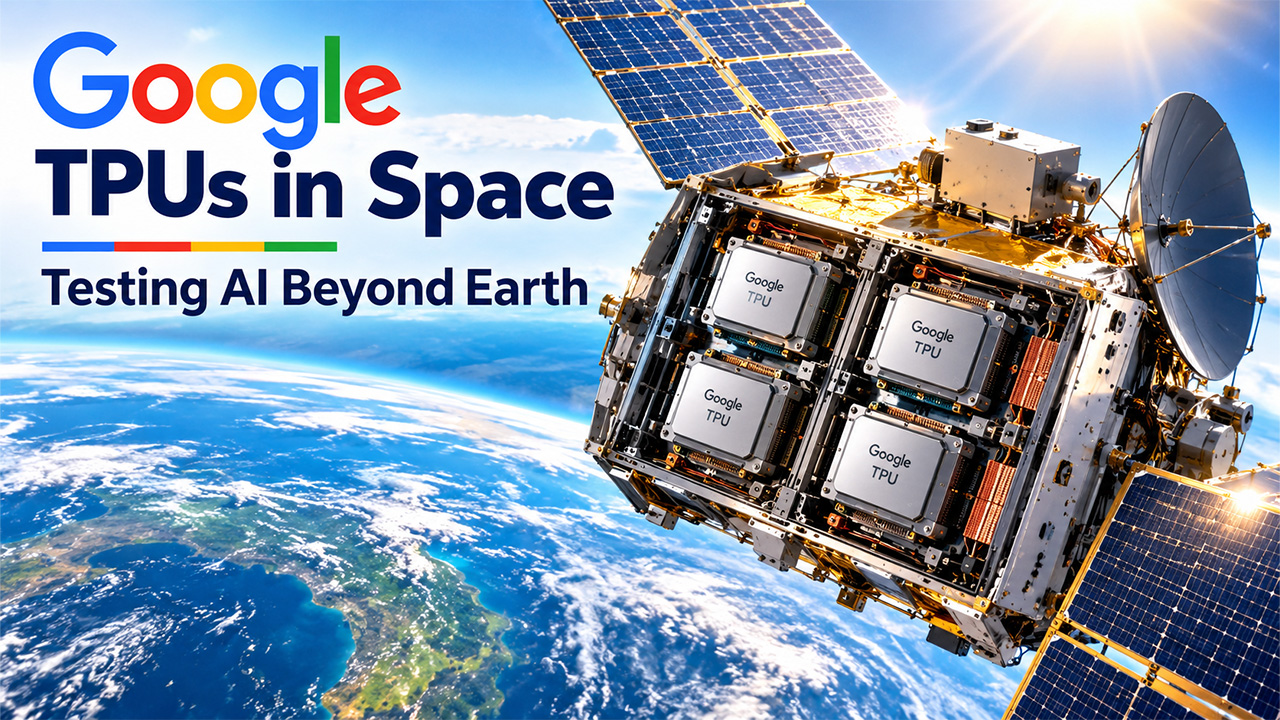
AI data centers in space are no longer sci-fi; Google just tested one. The company puts four Trillium Tensor Processing Units (TPUs) into low Earth orbit, making Google TPUs in space a reality as part of Project Suncatcher, an ambitious research effort that explores whether future machine learning infrastructure can operate in space.
Google’s prototype satellite launches on October 1, 2026, aboard SpaceX’s Transporter-18 rideshare mission. Built in partnership with Planet, the satellite marks the first physical test of Google’s idea to move AI computing beyond Earth. Google confirms that it makes contact with the satellite after launch and that the spacecraft operates as expected.
Google Tests AI Hardware in Space
Project Suncatcher all began with this very simple question: Can Google TPUs in space survive and work in orbit?
The prototype is equipped with four Trillium-generation TPUs. These processing units are optimized for machine-learning tasks and are already part of Google’s AI-based computing platform on Earth. Instead of deploying a typical data center, Google has chosen to load the systems onto a satellite to see how they perform in real-world orbital environments.
The moon mission isn’t a space data center, yet. It’s a hardware trial, meant to gather data for other projects to use later. Engineers are tracking how the chips react to the g-force of launch, radiation, temperature swings, and the even trickier task of dissipating heat in space. Google says the blastoff alone puts the payload through great physical stress. A trip to low Earth orbit takes about 10 minutes, during which spacecraft are subjected to intense vibration and acceleration, sometimes up to 50 to 100 times that of gravity.
Why Put AI Chips in Orbit?
Google’s interest in space computing comes largely from energy.
- Satellites in low Earth orbit receive sunlight for much longer periods than ground-based solar panels
- Google says satellites in suitable orbits can access up to eight times more solar power than comparable systems on Earth.
- This offers a potential way to supply large amounts of energy to future AI computing systems without relying entirely on terrestrial power infrastructure.
- The idea matters more as AI models demand more computing power.
- Conventional data centers need large amounts of electricity, land, cooling infrastructure, and other resources.
- Project Suncatcher explores whether some of that computing can eventually move into orbit, where solar energy is abundant.
Google’s long-term vision involves interconnected satellite clusters rather than a single spacecraft. Future satellites could carry dozens of TPUs and work together as a distributed computing system.
Cooling Remains a Major Challenge
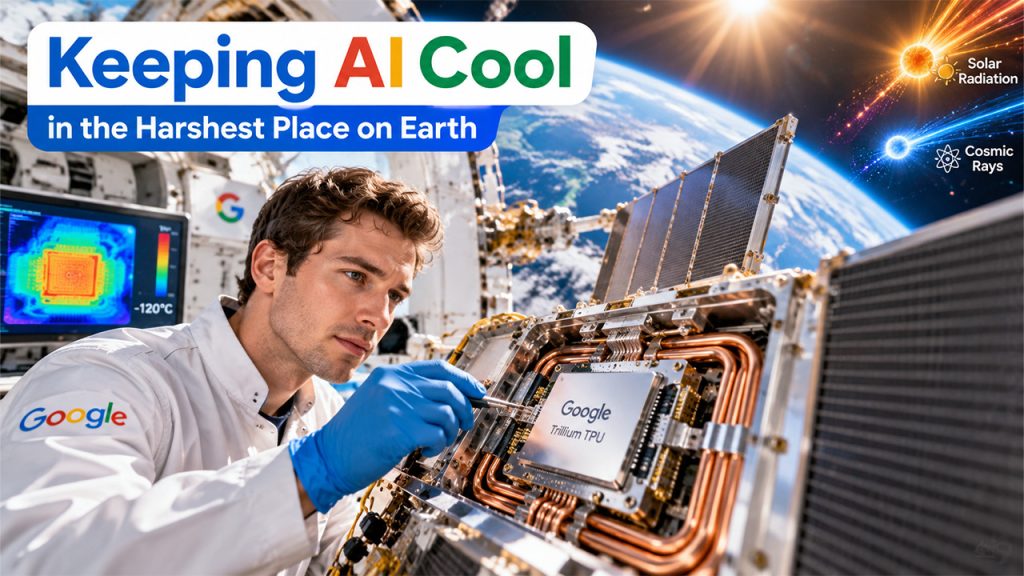
Cooling has to be another major challenge. Space has no air to pass over and push heat out from the AI processors. Google uses heat pipes and radiators, qualifying in thermal vacuum chambers before launch; the actual performance in space is the real test.
Another problem is radiation. Outside the Earth’s atmosphere, electronic devices are bombarded by solar radiation and cosmic rays. Google exposes its Trillium TPUs to proton radiation on the ground in order to test errors like bit flips. Google says the initial results are promising: its TPUs sustain more radiation than a five-year space mission, but clearly orbital data are still to be gathered.
Lasers Could Connect Future Satellites
A larger orbital AI system also needs fast communication between satellites. Google plans to use laser communication to connect future spacecraft. Each satellite needs to know its position and communicate with nearby satellites while they move rapidly around Earth. Maintaining a high-bandwidth connection between moving spacecraft requires extremely precise alignment. Google plans to test this part of the concept with two satellites in 2027. The goal is to determine whether multiple spacecraft can operate as a coordinated computing cluster in orbit.
Project Suncatcher Is Only the Beginning
Far from becoming a direct replacement for data centers on Earth, Google characterizes Project Suncatcher as an experimental research moonshot. The initial satellite is a modest test of whether the machinery can withstand the rigors of launch and operate in orbit.
If the experiment is successful, Google would be able to easily expand the idea with more robust satellite platforms, improved cooling and protection from radiation, and high-bandwidth links between craft.
At present, four Trillium TPUs in space aren’t enough to make a giant AI data center. But they are enough to give Google what its AI research team actually wants: Real-world data on Google TPUs in space. Project Suncatcher proves that AI infrastructure doesn’t have to stay on Earth, and now Google is testing that future in space.