
Microsoft has joined the AI cybersecurity race with the launch of MAI-Cyber-1-Flash, its first purpose-built cyber model. According to the announcement made by Microsoft AI, Mustafa Suleyman and Hayete Gallot confirmed on July 27 that the model now runs inside MDASH, Microsoft’s multi-agent vulnerability detection and remediation harness. The headline number: 95.95% on CyberGym, the benchmark widely treated as the gold standard for testing how well AI systems find real vulnerabilities in large codebases. Just as notable, Microsoft says the model delivers that performance at half the cost of its previous best-performing setup.
Here’s why that matters. Attackers are already using AI to scan huge volumes of code, hunting for the one weak spot that lets them in. The old approach to defense, where teams scan occasionally and patch when they get around to it, simply can’t keep pace anymore. Microsoft’s bet is that fighting AI-speed threats requires AI-speed defense, and MAI-Cyber-1-Flash is built specifically for that job.
What Makes MAI-Cyber-1-Flash Different
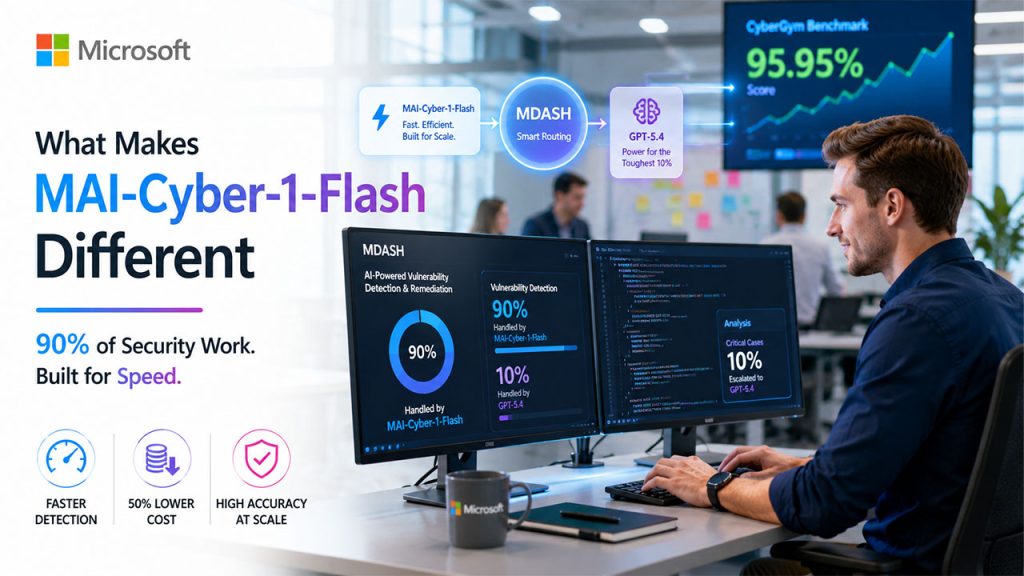
MAI-Cyber-1-Flash isn’t trying to be Microsoft’s biggest or smartest model. It’s built to be fast and efficient, which can handle the bulk of everyday security work cheaply. The clever part is how MDASH uses it: instead of running every task through an expensive, heavyweight model, the system routes around 90% of vulnerability detection work to MAI-Cyber-1-Flash and reserves the larger GPT-5.4 model for the toughest 10% of cases that genuinely need more firepower.
That routing decision is what drives the cost savings. Compared to Microsoft’s previous best MDASH setup (a combination of GPT-5.4, 5.4 mini, and 5.3 codex), this new configuration cuts costs by 50%, without giving up accuracy. This kind of task-splitting only works because of how AI agents work together instead of relying on a single model to do everything. Here’s how MDASH with MAI-Cyber-1-Flash stacks up against rival systems on CyberGym:
| System | CyberGym Score |
| MDASH + MAI-Cyber-1-Flash + GPT-5.4 | 95.95% |
| Mythos | ~84% |
| Gemini | 83.2%–85.6% range |
| GPT (standalone) | 83.2%–85.6% range |
That’s roughly a 12-point lead over the nearest competitor, according to Microsoft’s own figures.
Key Innovations Behind MAI-Cyber-1-Flash’s Performance
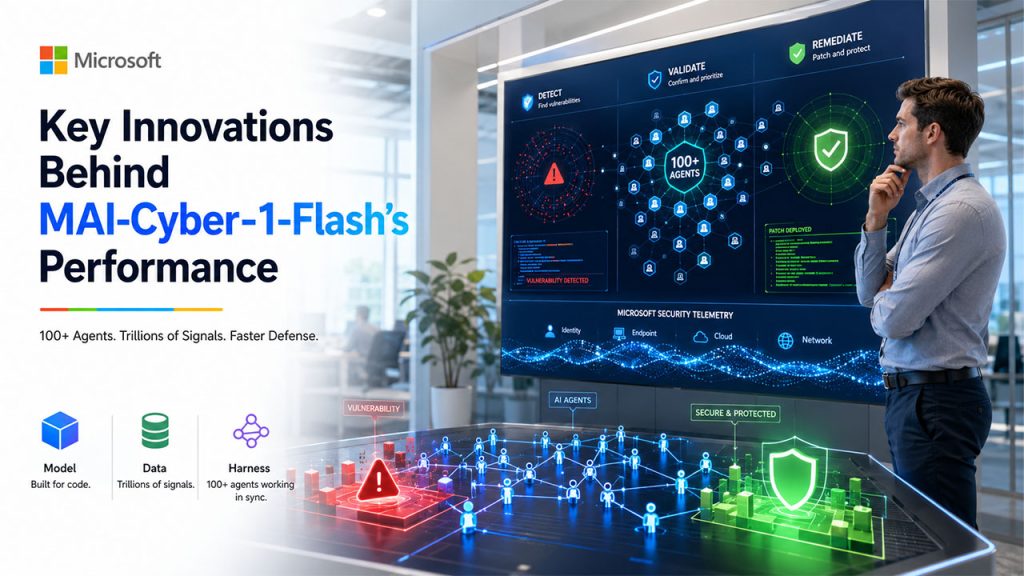
Microsoft credits the result to three ingredients working together:
Model:
MAI-Cyber-1-Flash is a compact, code-focused model built in-house from the MAI-Thinking-1 lineage, trained from scratch rather than fine-tuned on top of someone else’s base model.
Data:
Microsoft says its real edge is decades of security telemetry: over 100 trillion signals a day across identity, endpoint, cloud, and network systems, plus a long history of real-world exploits and how they were fixed.
Harness:
MDASH itself, tuned by security experts, coordinates more than 100 agents to find, validate, and remediate vulnerabilities across a codebase.
Alongside the model, Microsoft also introduced Perception, a new agentic security system built to monitor, patch, and close threats continuously, with MAI-Cyber-1-Flash expected to power more of its workflows over time. This move fits squarely within the broader top AI trends shaping how enterprises are adopting agentic systems.
Enterprise Security Features and Built-In AI Safety Guardrails
Because this is Microsoft’s first dedicated cyber model, the company says it leaned on its AI Red Team for adversarial testing, brought in independent third-party assessment, and wrapped deployment in enterprise controls like role-based access, tenant isolation, encryption, and sandboxed execution with no internet access.
The Bigger Picture
MAI-Cyber-1-Flash signals a shift in how AI security tools are being designed: not one giant model trying to do everything, but a system that knows which tasks are routine and which ones deserve real muscle. If that pattern holds, cheaper, smarter routing rather than raw model size may end up defining the next phase of AI-powered security.
Frequently Asked Questions :
Q. What is MAI-Cyber-1-Flash?
It’s Microsoft’s first AI model built specifically for cybersecurity, designed to find and help fix software vulnerabilities.
Q. What is MDASH?
MDASH is Microsoft’s multi-agent harness that coordinates over 100 AI agents to detect, validate, and remediate vulnerabilities.
Q. How much does MAI-Cyber-1-Flash cost compared to previous models?
It delivers the same or better results at roughly 50% lower cost than Microsoft’s earlier MDASH setup.
Q. What is CyberGym?
CyberGym is a benchmark used to measure how accurately AI systems can find real vulnerabilities in large codebases.
Q. What is Perception?
Perception is Microsoft’s new agentic security system that continuously monitors, patches, and closes threats using AI agents.