
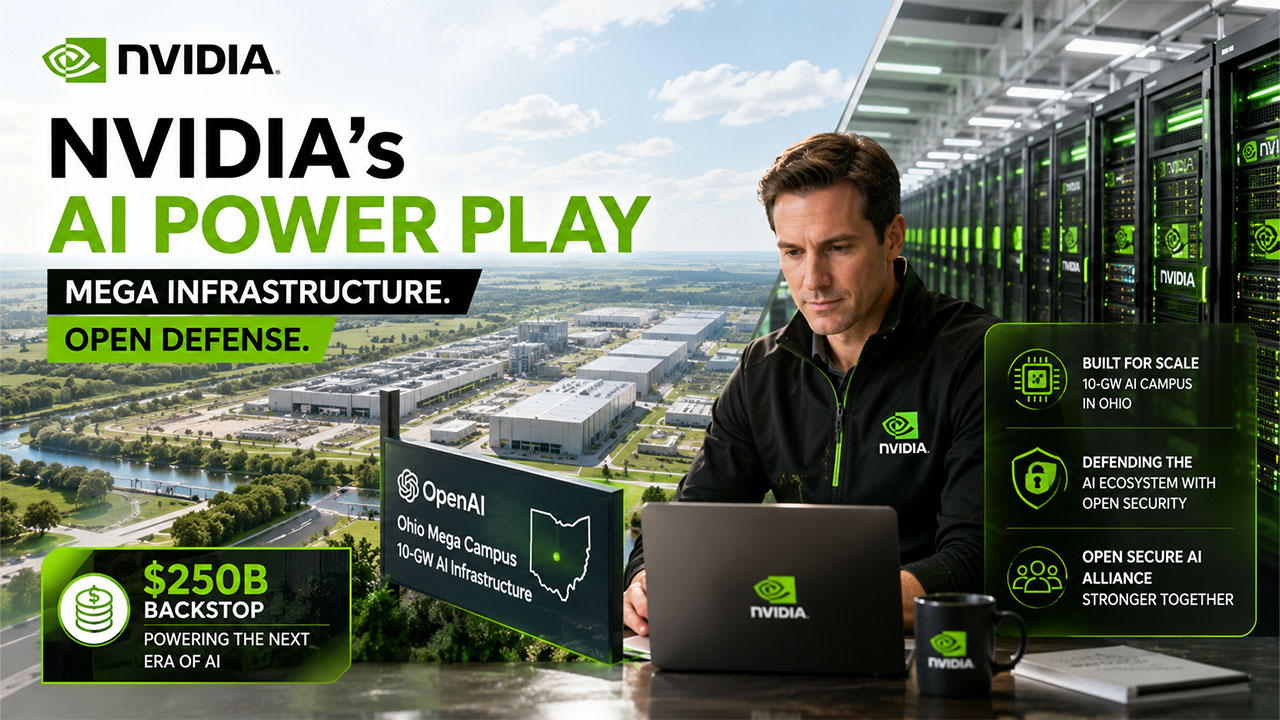
Nvidia has made two very distinct but equally impactful moves this week. Together, this says a lot about where the chipmaker is shaping its future: It is positioning itself to become both the financial pillar of the AI buildout and also the standard-bearer for keeping AI security defensible and open.
A $250 Billion Bet on OpenAI’s Ohio Campus
The most eye-catching headline is financial. Reportedly, OpenAI is in discussions with Nvidia about a backstop of around $250 billion to help fund a new AI data center, with the arrangement of enabling OpenAI raise depth for approximately 10-gigawatt campus in Pike County, Ohio, on the strength of Nvidia’s credit. The site, which is a decommissioned uranium-enrichment facility approximately 50 miles south of Columbus, is being created by SB Energy, which is the power subsidiary of Softbank.
The guarantee is necessary because of the credit situation of OpenAI. Presently, OpenAI does not have an investment-grade rating. Thus, the balance sheet of Nvidia would stand in effectively for one, enabling lenders price, the debt against the credit of the chipmaker rather than the borrower. The complete project, including chips, can go beyond $500 billion. This makes it the biggest data center development, which has been announced till date. However, the $250 billion commitment itself would have to apply only to the construction finance and lease, not the hardware. In a parallel and separate negotiation, Nvidia is also discussing financing the chip purchases of OpenAI, a figure that can easily go up to $350 billion.
As far as OpenAI is concerned, a deal like this would highlight a first step toward owning its own infrastructure instead of renting compute from Amazon, Microsoft, and Oracle. For Nvidia, it locks in demand for its chips for years to come. That is exactly why critics have voiced their concerns. Michael Burry, who is an investor of Nvidia, has termed the arrangement “around and around we go,” indicating the growing circular nature of AI financing, where chipmakers fund the very customers who can spend that capital purchasing more chips. Nvidia has already committed more than $40 billion to AI equity stakes, including approximately $30 billion in OpenAI itself. Nothing is yet final. Talks are still ongoing and can still change in the future.
Uniting an Industry Close to Open Security Tools
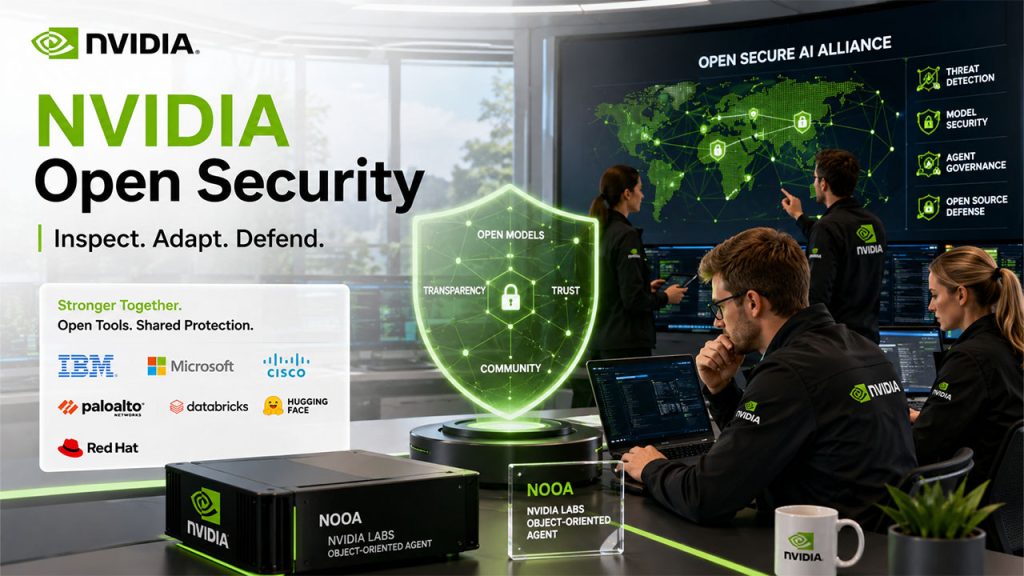
On the same day, Nvidia has taken a very distinct kind of position in terms of their leadership. It has unveiled the Open Secure AI Alliance along with a long list of founding partners covering cybersecurity, cloud, enterprise software, and AI research including IBM, Microsoft, Cisco, Palo Alto Networks, Databricks, Hugging Face, and Red Hat.
The main pitch is that AI defense should not live entirely inside a handful of closed platforms. Nvidia signals to a recent security incident at Hugging Face as the main case in point: when closed AI tools could not differentiate between attackers and defenders and blocked forensic analysis, the company faced an open-weight model operating on its own infrastructure to investigate the intrusion and contain it. This, according to Nvidia, is exactly why defenders require inspectable and open tools they can implement and adjust themselves. This is a need that is also encouraging businesses to go for AI business solutions developed for real-time compliance tracking and threat detection.
As a member of alliance, Nvidia has contributed to weights, open models, data, and a new open-source project known as NOOA (Nvidia labs Object-Oriented Agent), focused on making AI agent behavior simpler to trace, test, and govern. The alliance is also encouraging policymakers to consider open models as defensive assets instead of liabilities as AI regulations evolve.
The Common Thread
Distinct as they appear; both signal to the same goal: Nvidia is not content being just the supplier of chips. It needs to be the guarantor of financials which highlights the next infrastructure wave of AI, and the reliable convener establishing the rules for how such infrastructure gets protected. Irrespective of whether investors reward that growing footprint or begin worrying about the level of risks it is absorbing, it is a story that will be worth watching in months to follow.