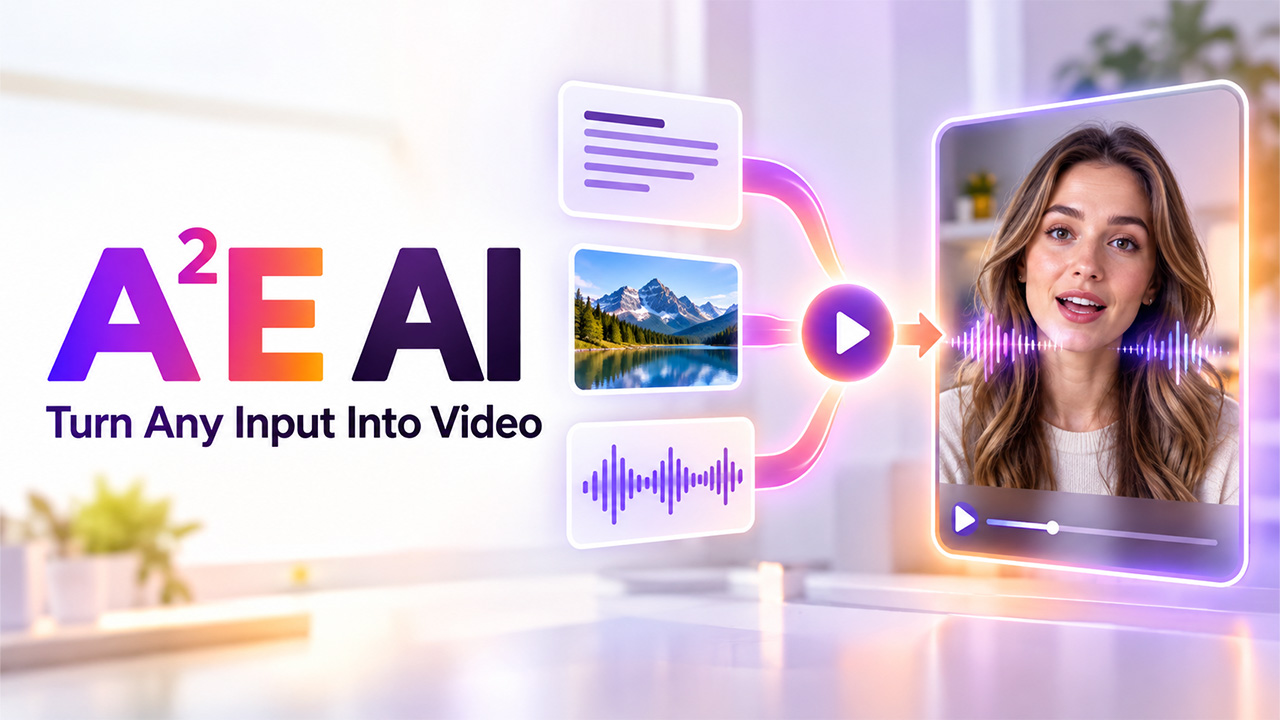
If you’ve been looking into AI-powered video creation tools, you’ve probably come across A2E AI at some point. It’s a browser-based platform built around turning text, images, or audio into video content, using AI avatars, lip-syncing, and voice cloning to do most of the heavy lifting.
What sets it apart from most other players is flexibility. Rather than restricting you to only one method of production, it caters to many kinds of inputs, which means that regardless of whether your content starts as a script, a picture, or an audio file, you can still end up with a video product without filming at all.
In this blog, we’ll walk through what A2E AI actually offers, who it’s built for, what it costs, and where it fits if you’re comparing it against other AI video platforms out there.
What Is A2E AI?
A2E AI is an AI-powered video generation platform focused on turning static content into dynamic video output, primarily through digital avatars, lip-syncing, and voice cloning. This software is designed to enable scalable and repetitive video creation processes, which, in the past, would take much more time due to the need for a camera and an editor.
The working principle of A2E AI revolves around the creation of a personalized avatar that will be responsible for creating lip-synced video based on different scripts or scenarios. Since there is no need to record anything on the spot, organizations can create a significant amount of video content without renting out a studio or hiring new talent for each project.
In other words, it is not just video editing software, but rather a video generation infrastructure that enables developers to use an API for implementing avatar-led video generation within their own software.
Key Features
Here’s what actually defines the A2E AI toolkit once you’re using it for real projects:
- AI avatar video generation: Make realistic digital avatars that have precise lip-syncing features, suitable for scalable video content creation.
- Image-to-video generation: Convert static images to video format, helpful when creating animated video content from one image without the need to shoot videos.
- Voice cloning: Generate a voice sample using AI based on audio, working together with avatar creation in generating videos.
- Multilingual lip-sync: Provides lip-sync for over 50 languages, suitable for teams that generate content for global customers.
- High-resolution output: Produces videos in 4k resolution, a big improvement over other competing software that limits output to 720p or 1080p resolution.
- API access: Allows developers to integrate avatar generation and video production within their applications using A2E’s API.
For teams building this into a broader AI business solutions stack, avatar-led video works well for onboarding content, product demos, and training material, cutting down the time and cost of traditional video production considerably.
Who Uses A2E AI?
A2E AI attracts a fairly specific mix of users, mostly people who need video content produced quickly and repeatedly, without the overhead of a traditional production process:
- Marketers: Producing on-brand video content at scale for campaigns, ads, and social media, without booking new shoots for every variation.
- Educators and e-learning teams: Building consistent avatar-led training content and course material that can be updated by editing a script, not re-filming.
- Developers: Incorporating avatar-based video creation directly into apps and products via API as opposed to using the platform independently.
- Content creators: Producing short-form video at a pace that wouldn’t be realistic with traditional filming and editing, similar to the workflow creators get from tools like PixVerse AI.
- Businesses and agencies: Making a high volume of video either for onboarding processes, demonstrations of their products, or campaigns.
The factor that unites all of these is scale. Whether it’s one video a week or dozens, the appeal is being able to produce consistent, on-brand content without the time and cost that traditional video production usually demands.
Pricing
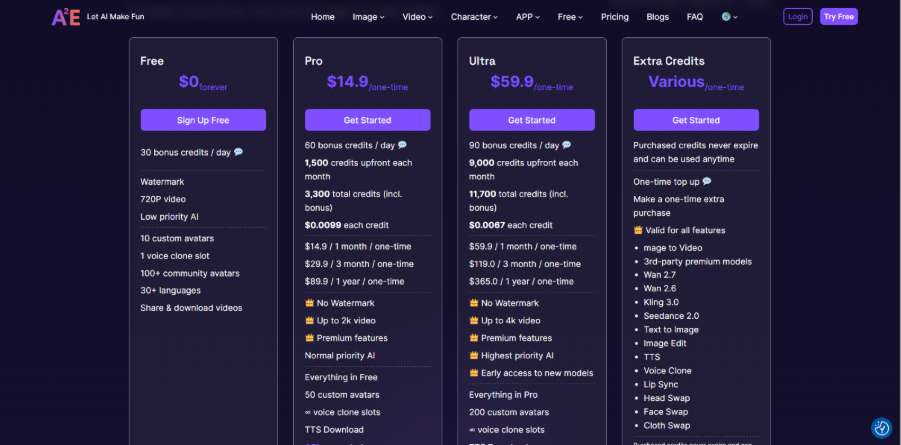
A2E AI pricing is simple, with four different plans: Free, Pro, Ultra, and pay-as-you-go extra credits, so that you can get started with something free and only upgrade when your needs grow. Here’s exactly how the plans break down:
The Free plan is, of course, free but requires no credit card to use. It provides 30 bonus credits to use. It provides 30 bonus credits per day, which gives you enough credits to try out 10 unique avatars, one voice clone slot, and 100+ community avatars in 30+ languages. The disadvantage here is the watermark on every video made, limited resolution to 720p, and lower-priority processing in case of heavy workloads.
The Pro plan costs $14.9 for one month, $29.9 for three months, and $89.9 for a full year, and removes the watermark from videos, allows 2k video output, offers premium features, and provides 60 bonus credits per day plus 1,500 credits upfront each month, with an approximate price of $0.0099 per credit.
The Ultra plan is the top tier, priced at $59.9 monthly, $119 for three months, or $365 annually. The plan boosts video output to 4k, provides 90 bonus credits per day, has 9,000 credits upfront monthly, and makes its price equal to $0.0067 per credit.
Pros and Cons of using A2E AI
Here’s the honest weigh-up once you’ve spent real time with A2E AI:
- Genuinely usable free tier: 30 Daily credits and access to community avatars mean you can test real output before paying anything.
- Strong value at higher tiers: The Ultra plan’s per-credit cost drops noticeably, making it a solid deal for high-volume users.
- Multilingual support: 30+ languages for lip-sync makes it a realistic option for teams producing content for global audiences.
- API access for developers: Avatar generation can be built directly into other products, not just used through the platform’s own interface.
- Watermark and resolution caps on free tier: 720p output and a watermark limit how usable free-tier videos are for anything public-facing.
- Credits don’t roll over on subscriptions: Unused daily or monthly credits are typically lost at the end of the cycle, unlike purchased top-ups.
- Output quality can vary by prompt: Like most AI video tools, results aren’t always consistent on the first attempt, occasionally requiring a few tries to get something usable.
For teams specifically comparing avatar quality across platforms, it’s worth seeing how a different approach, like Google Gemini Avatar Tool, stacks up before settling on one tool for the long run.
Conclusion
Ultimately, A2E AI is included among other AI video solutions because it pays attention to what counts regarding scaling, avatar generation, lip-syncing, and voice cloning that work together without needing a traditional production setup. The free trial is useful for checking how the tool works, while credit-based pricing works pretty fine as long as you understand how much you will use it.
And it may not suit everybody’s requirements. Those teams who require long video formats or the best-in-class video in one go could face limitations sooner than expected. However, for those teams who are looking for on-brand video content that can be produced within a limited time frame, the tool is very suitable.
When you wonder whether it’s worth implementing A2E AI into your workflow, the only right choice here would be to try its free trial version.
Frequently Asked Questions
Q. Is A2E AI free to use?
Yes, the Free plan costs nothing and includes 30 bonus credits daily, 10 custom avatars, and access to 100+ community avatars. It comes with a watermark and a 720p resolution cap, but it’s genuinely usable for testing the platform.
Q. How does A2E AI’s credit system work?
Credits are spent based on content type, roughly 1 credit per second for avatar or face swap video, and around 30 credits for a 5-second image-to-video clip. Higher-tier plans lower the cost per credit significantly.
Q. Does A2E AI support multiple languages?
Yes, the lip-sync feature works for over 30 different languages, which makes it a suitable product for teams working on avatars and content that is intended for an international audience without having to re-dub narration in each language.
Q. Can developers integrate A2E AI into their own apps?
Yes, A2E AI offers API access specifically built for developers, allowing avatar generation, voice cloning, and lip-sync features to be integrated directly into other products rather than only used through A2E’s own interface.
Q. Do unused credits roll over each month?
Generally, no. Daily and monthly subscription credits typically expire at the end of their cycle. Purchased credit top-ups work differently, though; they never expire and can be used anytime, regardless of billing cycle.