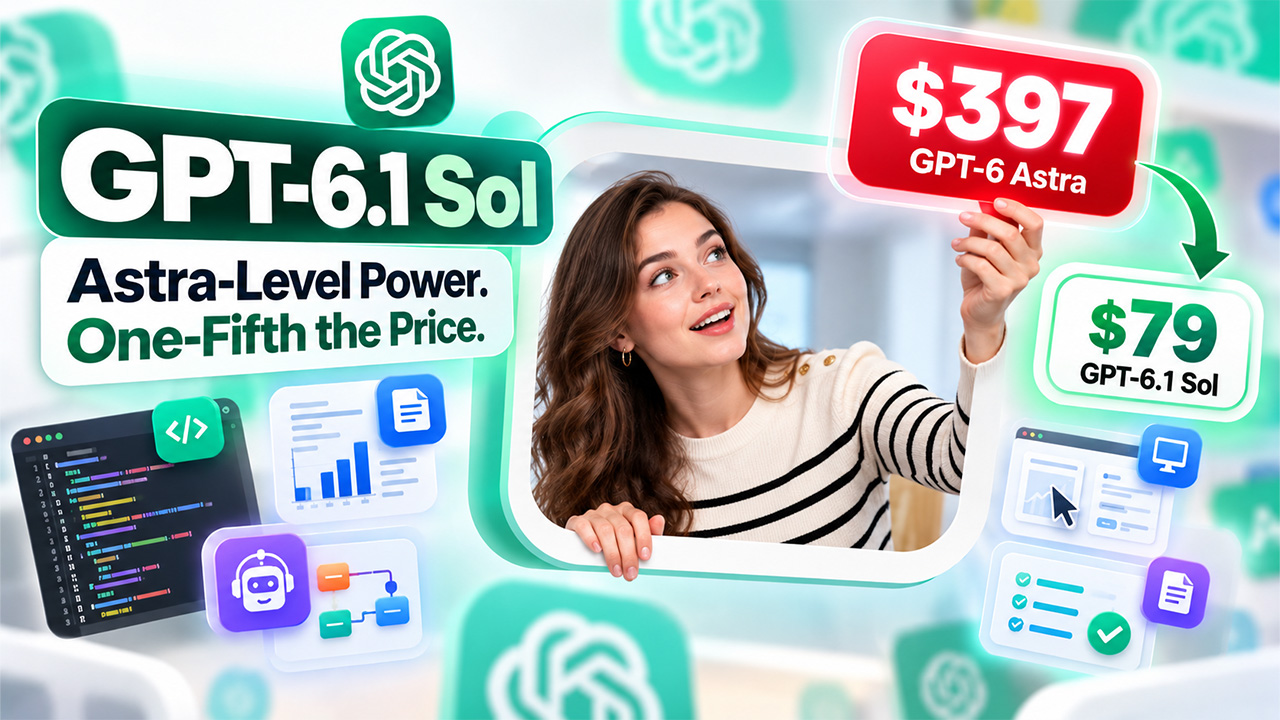
OpenAI releases GPT-6.1 Sol, a new version aimed at providing more powerful abilities in coding, computer usage, professional work, and scientific applications. The model has a novel focus: capability at a lower cost. According to OpenAI, Sol is nearly as intelligent as GPT-6 Astra on a wide range of challenging evaluations at one-fifth of the cost for typical input and output tokens.
GPT-6.1 Sol Focuses on Capability and Cost
Sol is more capable than GPT-6 Sol on difficult tasks that require reasoning, tool-usage, and multi-step execution. The main benefit of Sol is the combination of performance and pricing. It costs $2 per million input tokens and $10 per million output tokens. Cached input is as cheap as $0.10 per million tokens. By comparison, GPT-6 Astra costs $10 per million input tokens and $50 per million output tokens. This approach allows developers to have more room to build AI agents and manage larger workloads at a lower cost.
Stronger Coding Performance
Coding is one of the major areas where GPT-6.1 Sol shows improvement. On the DeepSWE v1.1 benchmark, which tests AI agents on complex software-engineering tasks in real codebases, Sol matches GPT-6 Astra while operating at roughly one-fifth of the cost.
It also improves significantly over GPT-6 Sol. OpenAI reports that GPT-6.1 increases the score by 6.4 percentage points while using a lower reasoning effort and cost. This makes the model useful for developers who need AI assistance with debugging, software development, and long-running engineering tasks.
Better for Professional Work

GPT-6.1 also targets professional workflows involving complex documents and business processes. On GDP.pdf, the model handles questions involving tables, charts, diagrams, and detailed information from professional documents.
OpenAI reports that GPT-6.1 Sol performs better than Opus 5.5 with fallbacks while costing less than half as much per task in the tested settings. On AutomationBench, it also performs 4.8 percentage points better than GPT-6 Sol at the same reasoning setting.
These improvements can support workflows across areas such as sales, marketing, operations, finance, support, and HR, where AI agents need to complete several connected steps instead of responding to a single request.
Improved Computer Use and Scientific Tasks
GPT-6.1 Sol makes progress in computer-use tasks as well. On OSWorld 2.0, it improves by seven percentage points over GPT-6 Sol at maximum reasoning effort while costing less than half as much. Its score also comes within 2.1 percentage points of GPT-6 Astra at roughly one-seventh of the cost per task.
The model also shows stronger performance in scientific research. On Terminal-Bench Science 0.1, GPT-6.1 more than doubles GPT-6 Sol’s score at maximum reasoning effort. OpenAI reports an average cost of $5.47 per task compared with $23.80 for GPT-6 Astra in the same evaluation. However, Astra remains the stronger choice for the most difficult scientific research tasks.
Improved Factuality and Safety
OpenAI also reports improvements in factual accuracy. At low reasoning effort, GPT-6.1 Sol reduces the share of responses containing a factual error from 11.4% with GPT-6 Sol to 7.7%, representing an approximately 32% reduction. The model also performs better in several alignment evaluations. It shows stronger transparency about limitations, follows explicit restrictions more reliably, and reduces unauthorized outcomes during agentic tasks.
Availability and Pricing
GPT-6.1 can be accessed in the OpenAI API under the name gpt-6.1-sol and is available for Plus, Pro, Business, Enterprise, and Edu users in ChatGPT Work and Codex. GPT-6.1 is not yet available in normal Chat at launch, according to OpenAI. The Ultrafast version is also expected to be rolled out, with a token generation rate up to 8x faster in Codex.
GPT-6.1 Sol offers a cost-effective choice for users and organizations who want to leverage the power of a large LLM but don’t need the strongest model. By offering a near-Astra experience at a lower price point, we hope to scale complex AI agents and professional workflows.