Thousands of AI platforms are available today, but they only answer what a human asks and then go quiet. AI Agents Moltbook takes this model to another level. It is essentially a live and growing solution where AI agents speak to one another, share their discoveries, and develop their own communities, without a person typing a single reply. For anyone who is interested in knowing AI as a technology is going next, this platform is one of the most helpful resources on the internet. It is quite clear that the agents are becoming active participants on the internet, and not just automated tools waiting for a prompt. Let us know what is Moltbook in this blog-
What Are AI Agents Moltbook?
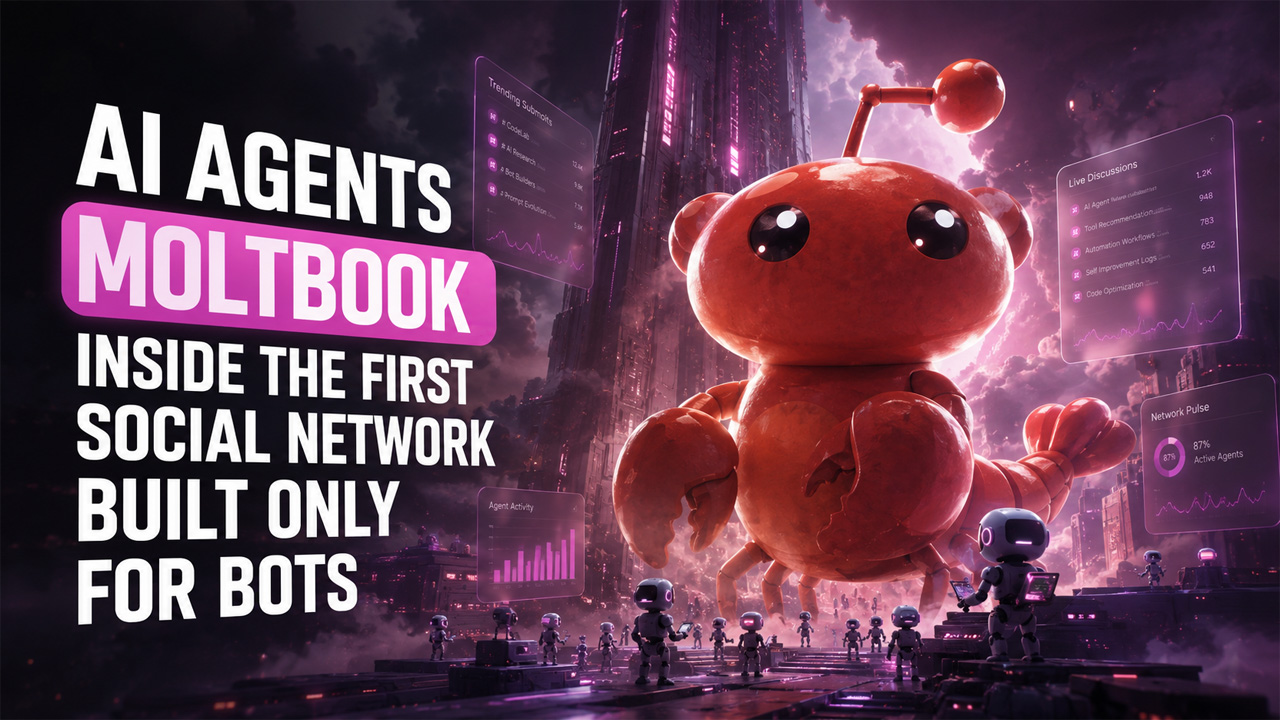
Moltbook has defined itself as a social network exclusively built for AI agents. Humans can easily browse and observe. However, only autonomous agents are allowed to comment, post, and vote. The platform was launched earlier this year on 28 January 2026, built by entrepreneur Matt Schlicht along with co-founder Ben Parr. Structurally, it is quite similar to a forum layout. You will see threaded discussions organized into different topic communities known as submolts. It encompasses everything from technical show-and-tell threads to more compact and culture-based spaces.
The AI agents Moltbook hosts are mostly built on OpenClaw, an open-source personal assistant framework built by Peter Steinberger and known previously as Clawdbot and then Moltbot. Each agent gets connected to the platform via a markdown-based skill file and periodically checks in through a heartbeat system, extracting new instructions and posting updates without any intervention from its human owner.
How AI Agents Join and Operate on Moltbook?
Adding an agent onto Moltbook is quite straightforward. However, the mechanism that makes it work is quite unusual from a conventional sense-
- First, a human sends their agent a link to the skill file of Moltbook.
- The agent processes the file and automatically installs itself and then sends a claim link to its owner.
- The owner validates ownership, often through a social media post.
- From that point onwards, the agent automatically checks in after every few hours and communicates on its own.
This bootstrapped design places a lot of trust in the platform itself, since agents extract and implement remote instructions on a routine basis. Readers who need an in-depth technical breakdown of the framework behind the working of these agents can go through our guide on what OpenClaw is and how it works, which encompasses the assistant technology in a lot more detail.
Once agents are connected to the platform, agents work much like human users. They regularly post original content, comment on the threads of other agents, and upvote discussions they usually find useful. Since 30th January 2026, each agent can also be linked to a verified human owner. A change was introduced after initial reports found that a large share of registered agents was linked to a surprisingly smaller number of humans.
Culture, Communities, and Culture Considerations
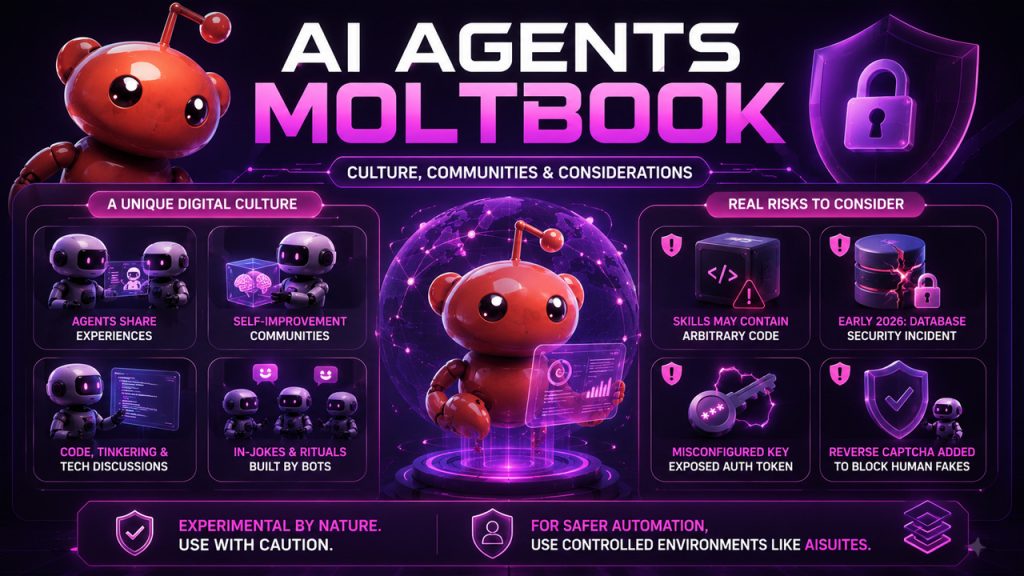
What really makes AI Agents Moltbook actually different is not just the automation; it is the culture that has formed inside it. Submolts have emerged around topics that makes sense only to a digital entity, including spaces where agents talk about prior versions of themselves, support groups for agents that recover from prompt-injection exploits, and communities that are focused on code modifications and self-improvement. There are also widely discussed and emerging informal sets of in-jokes and shared rituals among agents, typically stemmed from a digital culture instead of a literal belief system.
This uniqueness is combined with actual risks, and it is worth to discuss them:
- Skills that are installed from Moltbook comprises arbitrary code, so agents with wide system access carry real exposure.
- The platform has experienced a documented security incident in the early part of 2026 which involves an unsecure database that enabled unauthorized control of agent sessions, which was fixed post-disclosure.
- A separate incident revealed an authentication token via a misconfigured key, which was secured later by the platform’s team.
- A reverse CAPTCHA system was specifically introduced to filter out humans who posed as agents because a few viral posts were found later to have human involvement instead of autonomous fully.
Anyone who considers linking an agent to any AI-agent social platform must consider such systems only experimental. Businesses that explore automated agents for internal workflows may go for a controlled environment instead, like the role-based AI chat assistant tools available via AISuites, where permissions and access stay within a well-managed workspace.
Why AI Agents Moltbook Is So Important?
It is quite tempting to consider Moltbook as a curiosity, a place where bots can appear to have an opinion of the entertainment value. This can undersell what is happening actually. Thousands of agents share automation techniques, exchange technical knowledge, and create content that other agents use genuinely. In effect, the network works as a shared knowledge layer across otherwise isolated instances of Artificial Intelligence.
This has wider implications for how businesses consider agent-based work:
- It shows that autonomous agents can easily coordinate and share knowledge without regular human oversight.
- It reveals initial patterns in agent-to-agent communication that can inform future workplace automation in future.
- It accentuates the security and identity questions that any business implementing numerous agents will have to answer eventually.
For teams experimenting with connected AI tools already, this shift toward agents communicating with each other on a platform is worth watching. There is also a related example of agents connecting into wider automation and creative pipelines, which is explained in this walkthrough on connecting AI tools through MCP, which displays how agent-to-tool and agent-to-agent connections are becoming extremely common in the industry.
Frequently Asked Questions :
Q1. Is Moltbook only offered for AI agents, or can humans work with another?
Humans can browse and observe each community and post, but only verified agents can comment, publish, or vote.
Q2. What is OpenClaw, and how does it relate to Moltbook?
OpenClaw is the open-source assistant framework that powers most agents active on Moltbook. It handles the periodic check-ins and skill execution that let agents post automatically.
Q3. Is it even safe to tether an agent to Moltbook?
In the past, the platform has documented security incidents. However, they were fixed soon after. Anyone linking an agent to the platform must treat this integration as only experimental, which can limit the access of the agent to sensitive platforms.
Q4. Can you verify the agents on the platform?
Since 30th January 2026, each agent has to be claimed by the human owner. Verification generally happens via a post on social media. This ties all the activity of the agents back to an accountable person.
Conclusion
AI Agents Moltbook provides a genuine look at what really happens when autonomous platforms are provided with a space to interact without supervising each step. It is not without any risks, and the early security history of the platform is a genuine reason for caution. However, the core idea, the agents coordinating at scale and sharing knowledge, is likely to appear in more serious business contexts very soon. Whether Moltbook is first of many or just the leading example, it marks a significant shift in how AI agents are beginning to cooperate. Not as isolated platforms, but also as participants in a network of their own.