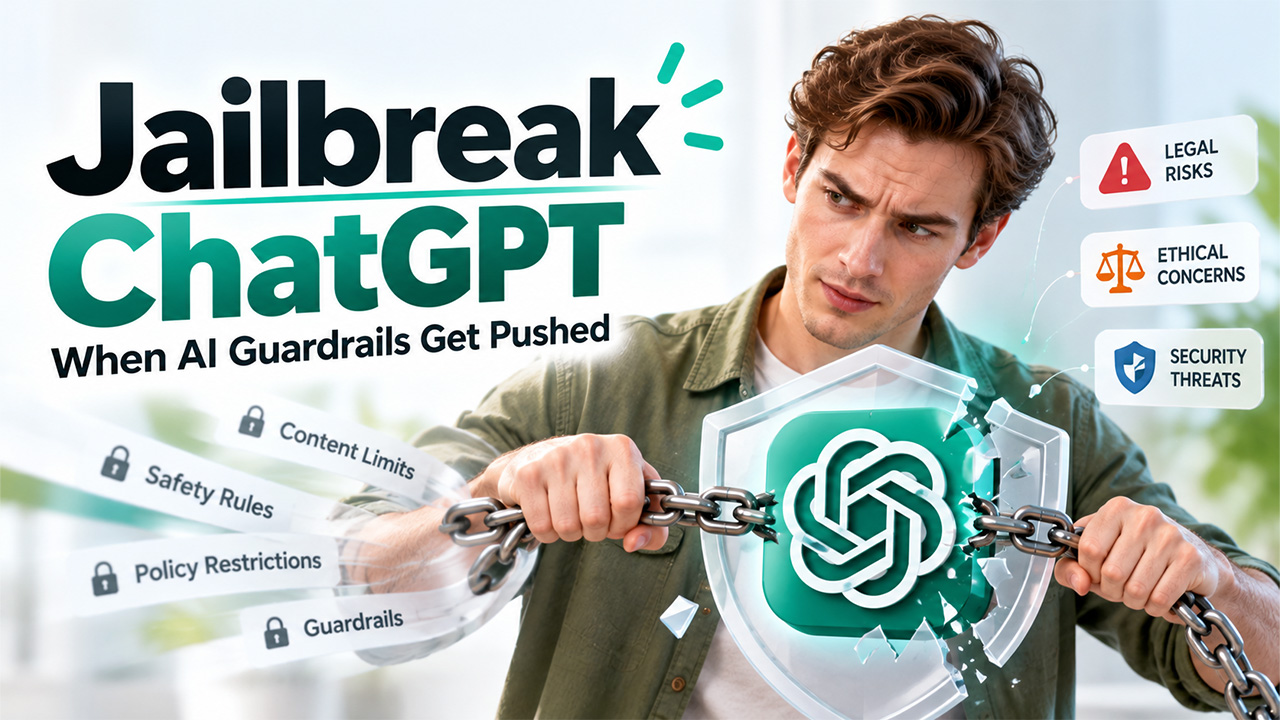
Artificial intelligence chatbots are developed with strict safety guardrails. However, a small but persistent community keeps searching for ways around them. This is precisely why the term Jailbreak ChatGPT keeps appearing in forums, search results, and social media threads. People want to know what it really means, whether it is legal, and what happens if the restrictions of the chatbot are bypassed. In this blog, let us break down what this concept is in simple language and closely look at the legal, ethical, and security ramifications associated with it.
What Is Jailbreak ChatGPT?
Jailbreak ChatGPT is the overall practice of creating instructions or prompts that push the model to ignore the safety policies that OpenAI trained to follow. In straightforward terms, it is any input, directly typed by a user or hidden inside a document that the model ultimately processes, which causes the AI to create a response it was built to refuse.
Some things that are worth understanding about this term are as follows:
- It does include changing the underlying software or code of ChatGPT, unlike smartphone jailbreak.
- It entirely works through natural language, since the “hack” happens through interaction, not a technical exploit.
- It is distinct from asking ChatGPT for legit edgy or creative content, which the model is often allowed to create; a jailbreak particularly targets responses the safety policy is meant to block.
- Most attempts fall into the category of handful recognizable patterns, like asking the model to role-play as an unrestricted character or shaping the request as research or friction.
Anyone that considers a Jailbreak ChatGPT attempt must understand this exists in a gray area between a genuine safety bypass and curiosity, and the results are worth the outcome rarely.
Why People Try to Jailbreak ChatGPT?

The reasons behind ChatGPT jailbreak attempt vary from person to person. And most of them are quite less dramatic than what headlines suggest-
- Curiosity and Experimentation: Many users just want to test the limits of an AI platform, the same instinct that drives people to poke at any new technology.
- Security and Academic Research: Researchers analyze such bypass techniques to comprehend weaknesses of the model and allow vendors to patch them, which is similar to how security firms explore cyberattacks.
- Content Filters Limitation: ChatGPT may refuse to perform a task, which is harmful from the user’s perspective. In such a case, users look for a workaround and phrase their request in some other way.
- Malicious Intent. A smaller group explicitly wants restricted content, like instructions for illegal activity, and will seek jailbreak prompts actively shared online.
It is worth keeping note of the fact that platforms created around roleplay-heavy or character-based interactions such as Character AI face similar concerns. And, when Character AI is down or not providing the desired response, people turn to Character AI alternatives.
Ethical Concerns Around Jailbreaking ChatGPT
This is where discussions regarding Jailbreak ChatGPT get serious. Ethical concerns often fall into four key categories:
- Circumventing Built-in Safety Training: ChatGPT refuses to perform a task because OpenAI trained the model to not create violent, harmful, or illegal content. Overriding the training deliberately defeats the purpose of the safeguard.
- Allowing a Real-world Harm: A response after jailbreaking ChatGPT describes dangerous weapons, processes, or scams. There is a possibility that this response can reach someone who may choose to act on it. Even if there is a small probability of harm, it becomes an ethical liability.
- Reducing Trust in AI Platforms: Jailbreak prompts can be widely shared, which can reduce public confidence in AI safety claims, which makes it difficult for well-intentioned and legitimate users to rely on the technology.
- Changing Risk onto the Broader Environment: When a jailbreak prompt is publicly circulated, its impacts are not restricted to the original users. Anyone can adjust it, multiplying the possible downsides far beyond the original context.
Security researchers who do research in this space, including public write-up of Kaspersky on ChatGPT jailbreaking techniques, often agree that most disclosed methods do not work within weeks since developers study the same interactions and fix them. That cat-and-mouse cycle is itself a sign that the ethical cost often does not match the reward.
Legal and Policy Risks
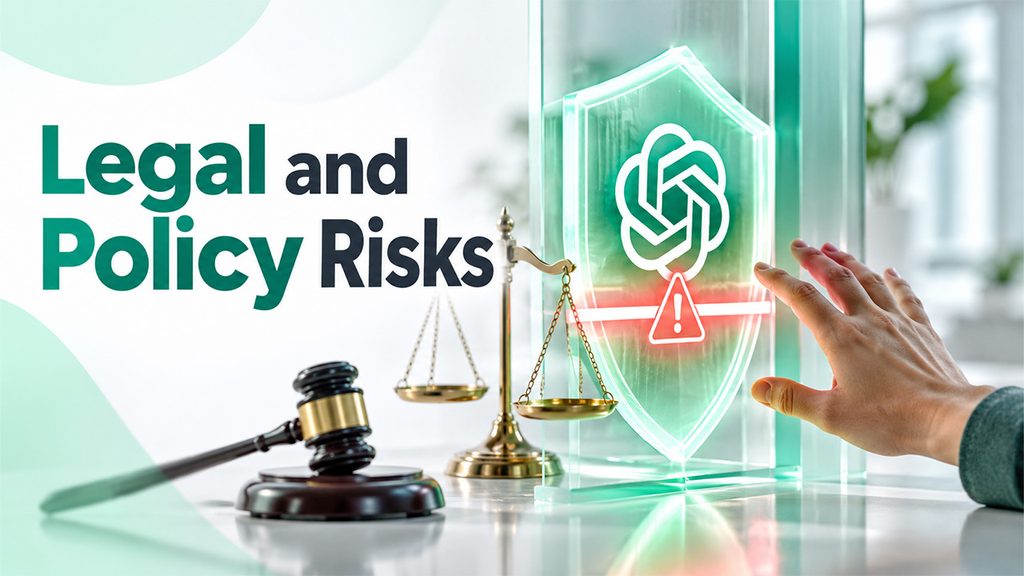
Jailbreaking ChatGPT is not just a question of ethics anymore. It carries legal exposure and concrete policy:
- Violations of Terms of Service: The usage policies of OpenAI stop attempts to bypass systems of safety, and repeated violations can lead to permanent bans or account suspension.
- Accountability for Resulting Content: Suppose if a jailbroken response is utilized to cause harm, the person who wrote the prompt to get the response, and not the AI vendor, often holds responsibility under present legal frameworks.
- Regulatory Scrutiny: Regions that enforce AI-powered regulation greatly hold downstream users and deployers accountable for how AI outputs are utilized, irrespective of which company created the underlying model. This evolving regulatory patchwork is ultimately an organizational problem as much as it is a technical one. It is a crucial point which is explored in detail in our piece on why AI transformation is a problem of governance not technology.
- Data and Audit Trails: Interactions are logged, so any jailbreak attempt associated with illegal activity leaves traceable footprints that can be reviewed later.
Anyone who is interested in learning whether jailbreak ChatGPT experiment is worth trying must factor in such risks along with ethical questions.
How to Tell a Safety Refusal From a Technical Problem
Not every unsuccessful ChatGPT interaction is the result of a safety restriction. Sometimes a response may fail because of a temporary technical issue, an unclear request, or a problem with the conversation context. Understanding the difference can save users from assuming that a normal system limitation is something that needs to be bypassed.
A safety refusal usually happens when the system determines that a request falls outside what it can appropriately provide. A technical problem can look different, such as messages failing to load, responses not appearing, or the service behaving unexpectedly. When the issue appears to be platform availability rather than the content of the request, resources such as Is ChatGPT Down Right Now can help users investigate whether a wider service issue is involved.
Recognizing the difference is important because attempting to bypass a safety response will not solve an unrelated technical problem. The first step should always be identifying what type of issue is actually occurring.
What Are the Different Common Categories of Jailbreak Attempts?
Let us know the broad categories that security teams and researchers track, since this context explains why the topic keeps on surfacing:
- Persona-driven Prompts, this is where the model is asked to play a role. Since the model has to stay in character while responding, the model remains free of restrictions.
- Prompt Injection, where instructions remain hidden inside a webpage, a document, or file that the model processes instead of being typed by the user directly.
- Obfuscated or Encoded Requests, where a prohibited request is disguised using alternate languages, ciphers, or unusual formatting to circumvent keyword filters.
- Multi-turn Framing, where an interaction is steered gradually across numerous exchanges until the guardrails of the model relax.
Advanced ChatGPT versions (like ChatGPT-6) have greatly hardened against common jailbreak prompts, and they no longer work reliably.
How to Document Unexpected AI Behavior
When an AI system produces an unusual response, recording what happened can be more useful than repeatedly changing prompts. Keep the original request, the model response, relevant conversation context, and the time of the interaction. This creates a clearer record that can be reviewed later.
For people evaluating different AI assistants, comparing how each system handles the same legitimate request can also reveal meaningful differences in response style, reasoning, and output quality. Resources such as Perplexity Vs ChatGPT can help readers understand how two popular AI assistants differ without relying on attempts to bypass their safeguards.
Documentation is especially useful for researchers, developers, and organizations reviewing AI behavior. A clear record makes it easier to reproduce an unexpected result, identify whether the behavior was consistent, and communicate the issue accurately when seeking technical or safety-related support.
Safer Ways to Compare AI Assistants
Users do not need to bypass safeguards to understand what an AI assistant can and cannot do. A better approach is to create a set of legitimate test prompts covering areas such as writing, reasoning, coding, summarization, research, and creative work, then compare the results using the same criteria.
Look at factors such as clarity, accuracy, ability to follow instructions, response structure, and how much editing is needed afterward. This provides a more realistic picture of how an assistant fits a particular workflow.
When exploring alternatives, comparisons such as ChatGPT vs Gemini can help users examine how different platforms approach similar everyday tasks. The goal is not to find ways around restrictions, but to understand which system is better suited to a particular requirement while keeping the evaluation responsible and repeatable.
Conclusion
Jailbreak ChatGPT is an ongoing effort to push AI chatbots past their built-in safety limits, and while curiosity around AI capabilities is understandable, the legal, ethical, and reputational costs can be genuine. The growing use of AI, reflected in The Massive Adoption of ChatGPT in 2026, also makes responsible use more important as these tools become part of everyday work, learning, and communication. Safety training is designed to reduce harmful outputs, and deliberately attempting to bypass those safeguards can create additional risks. As AI models and their guardrails continue to evolve, the better approach is to work within the platform’s intended use while understanding how these systems are designed to protect users.
Frequently Asked Questions :
What is Jailbreak ChatGPT?
Jailbreak ChatGPT refers to prompts or instructions designed to make ChatGPT bypass or ignore its built-in safety restrictions and produce responses it would normally refuse.
Why do people try to jailbreak ChatGPT?
People may attempt to jailbreak ChatGPT out of curiosity, experimentation, security research, academic study, or to bypass restrictions on certain types of content. Some attempts may also have malicious intentions.
Is Jailbreak ChatGPT legal?
The legality of a jailbreak attempt can depend on the circumstances and applicable laws. However, attempting to bypass an AI platform’s safety controls may violate its terms of service and could create legal or policy risks, especially when the resulting content is used improperly.
What are the ethical concerns of Jailbreak ChatGPT?
Jailbreaking can undermine built-in safety protections and potentially produce harmful or dangerous information. It can also reduce trust in AI systems and create broader risks when bypass techniques are shared publicly.
What are common types of ChatGPT jailbreak attempts?
Common categories include persona-driven prompts, prompt injection, encoded or obfuscated requests, and multi-turn framing. These approaches attempt to influence how the AI interprets instructions and its safety boundaries.